
It is 7:50am on a Friday in December and your phone is already lit up. Art Basel weekend is on, a couple just landed at MIA, and they want a convertible for four days starting this afternoon. You have the car. You also have two voicemails from last night you never heard, both the same kind of booking, both now sitting in someone else’s lot. Across town the big airport brands are quoting the same car at a rate padded with concession and facility fees, and you are the cheaper, faster option if, and only if, you actually pick up.
Here is the short version. Miami is not a flat rental market. Your year runs on a long winter high season, a spring-break and events spike, and a nervous hurricane-season trough, and a stack of Florida and airport fees shapes your margin on every rental. Build the calendar you already have, protect the fleet before the storms, capture every winter inquiry, and work the summer dead weeks with offers and a storm plan instead of hoping, and your cars keep earning when the market around you gets jittery. This is the season-by-season build, the places it breaks, and the Miami copy you can paste in today.
Key Takeaways
- Miami’s surge is winter, not summer. Greater Miami drew a record 28 million visitors in 2024, who spent about $22 billion (GMCVB). The snowbird-and-tourist crowd that fills your lot lands November through April.
- Florida fees shape every rental. MIA passes through a Customer Facility Charge of about $5.35 a day (DWU Consulting) and a concession recovery fee of roughly 10% of the rental on airport pickups, and Florida adds a $2-per-day surcharge under Fla. Stat. 212.0606 on the first 30 days.
- Hurricane season runs June 1 to November 30, with the peak from mid-September into October (NOAA). That window is your trough and your single biggest operational risk, so it needs a written plan, not a prayer.
- An idle car still bleeds. A rental vehicle averaged about $1,387 a month in revenue in 2024 (Geotab), so every car parked through a slow August is forgoing roughly that much, before depreciation and insurance.
Table of contents
- What Miami’s calendar does to your fleet
- The Florida fees that quietly set your Miami margin
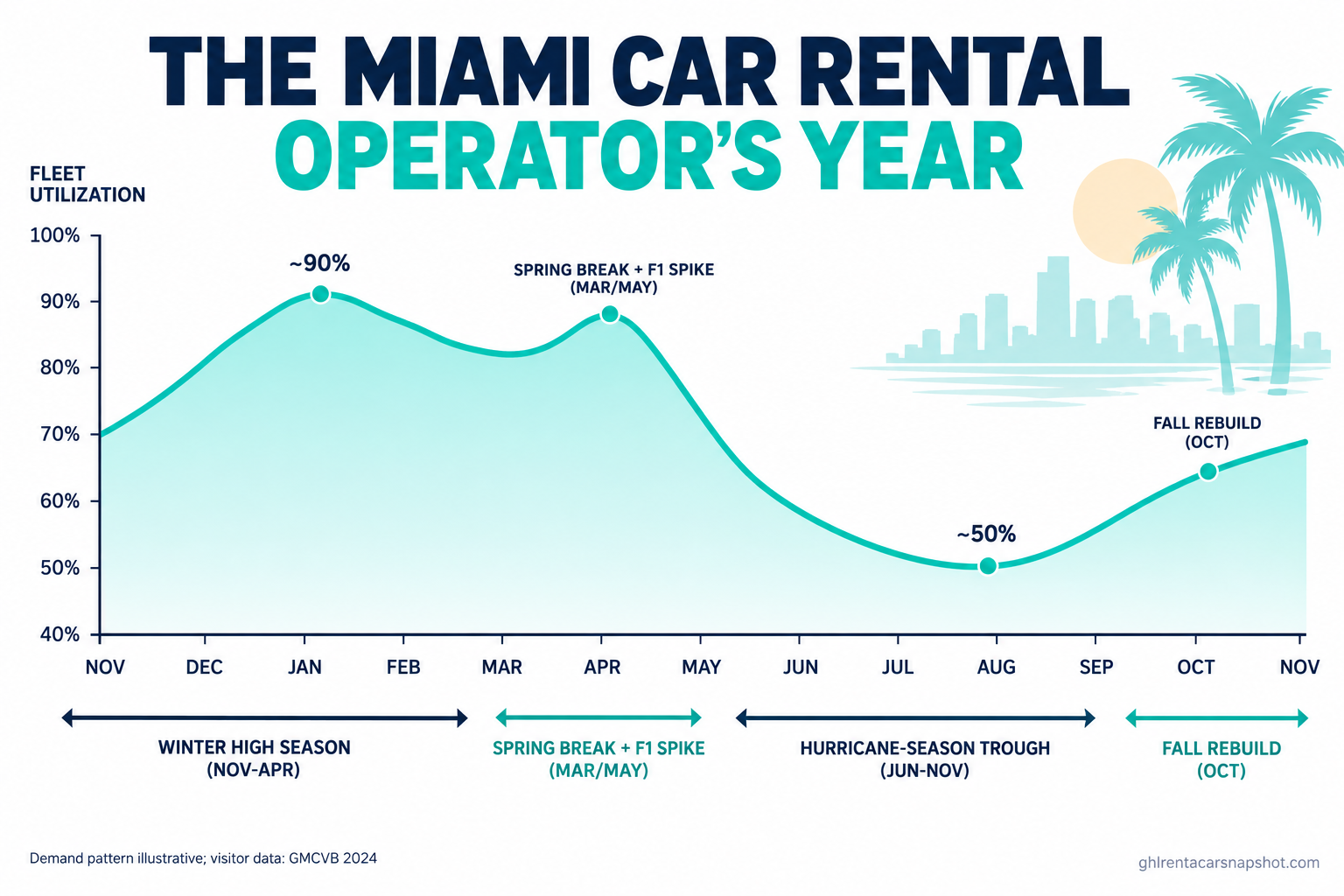
- The Miami operator’s year: four seasons, four jobs
- Season 1: The winter high season (November to April)
- Season 2: Spring break and the events spike (March and May)
- Season 3: Hurricane season, your real trough (June to November)
- Season 4: The early-fall rebuild (late September to October)
- Three scenarios: solo, mid-size, large fleet
- The Florida compliance layer most operators miss
- Common objections, answered
- Frequently asked questions
What Miami’s calendar does to your fleet
Most rental advice treats the year as one flat line. In Miami that wrecks you twice: once in winter when you are too small for the demand, and once in late summer when you are too big for it. The city swings on a tourist economy that crests hard in the cool, dry months and thins out when the heat, the humidity, and the storms arrive.
The winter crest is real money. Greater Miami pulled a record 28 million visitors in 2024, who spent about $22 billion and supported more than 209,000 tourism jobs, per the Greater Miami Convention and Visitors Bureau. That crowd does not spread evenly. Snowbirds, holiday travelers, Art Basel in December, and a packed events calendar pile demand into roughly November through April, when the weather is best and the airport is busiest.
Then it flips. Summer is hot, wet, and quieter on the leisure side, and layered on top is hurricane season. Your fleet does not care about averages. It cares about the specific Friday a storm is three days out and half your reservations cancel while the other half scramble to leave town. So the first job is to stop pretending you run a steady business. You run one with a tall winter, a jumpy summer, and event weekends that behave like their own holidays.
The Florida fees that quietly set your Miami margin
Before the seasons, understand the money that comes off the top no matter the season. If you pick up at the airport, two charges ride on every rental. MIA levies a Customer Facility Charge, listed at about $5.35 a day (roughly $74.90 over a 14-day rental) under the Miami-Dade Aviation Department’s operational directive, per DWU Consulting’s fee tables. On top of that sits a concession recovery fee, which the airport brands pass through as a percentage of the rental, commonly cited at around 10% of the total on third-party rental guides. Miami-Dade does not publish a clean consumer-facing schedule for the concession percentage, so treat that 10% as a working estimate and read your own airport agreement for the exact number.
Then there is the state charge that applies to almost everyone. Florida imposes a $2-per-day surcharge on rentals of vehicles built to carry fewer than nine passengers, under Fla. Stat. 212.0606. It applies to the first 30 days of a rental and you are required to collect it. Here is the part that matters for an independent: the statute exempts rentals from locations owned or operated by an airport authority. So the on-airport majors are structured around their own fee stack, while an off-airport lot like yours collects the $2 surcharge but skips the concession and facility charges entirely.
That gap is your pricing weapon all year. An off-airport Miami operator can show a lower all-in number than the airport counter on the identical car, which is exactly the kind of advantage worth leaning on. I walk through the broader version of that play in running an airport rental without the counter.
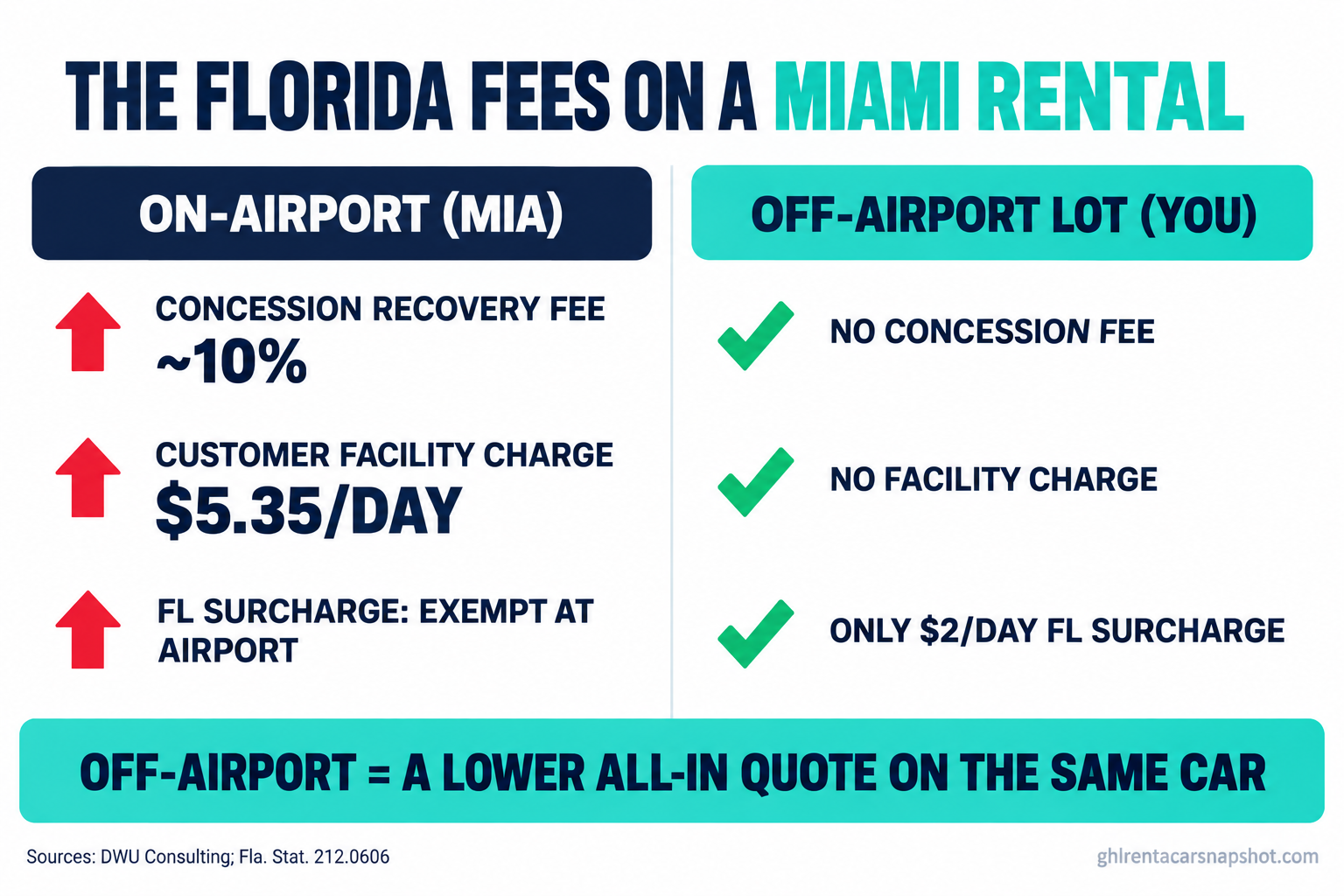
Example fee stack on a 7-day, $350 base-rate Miami airport rental, USD. The concession recovery fee and Customer Facility Charge apply to on-airport pickups, which an off-airport lot avoids; the $2/day Florida surcharge applies to off-airport rentals but is exempt at airport-operated locations. Base rate is illustrative. Sources: DWU Consulting, Fla. Stat. 212.0606.
The Miami operator’s year: four seasons, four jobs
Each season asks a different job. Winter is about capturing demand you already have. Spring is about pricing the spikes right. Summer is about protecting the fleet and keeping the trough off zero. Early fall is about rebuilding the pipeline before the snowbirds return. Run one generic playbook across all four and you overspend in summer, underprice in winter, and get caught flat-footed when the first named storm forms.
Season 1: The winter high season (November to April)
This is where you make most of your year. The phone rings, the website gets traffic, and the only real question is how much of that demand you actually catch. In a busy winter the leak is not marketing. It is response time. You are out on the lot handing over keys when the next three inquiries land, and if nobody answers within a few minutes, the renter books the next lot on the map.
The fix is to make sure no inquiry waits on you being free. A missed call should trigger an instant text back, a web form should get an automated first reply with a booking link, and a quote request should route into a pipeline with a timed follow-up so nothing sits. That is the whole point of a missed-call text-back system: it answers in seconds while you are busy, so the busy season does not quietly cap itself at the number of calls you personally had time to pick up.
Winter is also when you can hold your rates. Demand is high, so this is the season to stop discounting out of habit and let the calendar earn. If you are not already adjusting rates by demand, winter is the easiest place to start, and I lay out the mechanics in the car rental pricing strategy guide.
Where winter breaks: overbooking. When demand is this strong, a double-booking is not a rare accident, it is the default outcome of a busy counter with no single source of truth. One car promised to two renters on the same Saturday turns a five-star winter weekend into a refund and a one-star review. Keep one live availability view across your website, your phone bookings, and any platform listings so a car that is spoken for cannot be sold again. I cover that sync problem in stop double-booking your fleet.
Season 2: Spring break and the events spike (March and May)
March brings spring break, and Miami gets a wave of younger renters, more one-day and weekend rentals, and more demand for anything that looks good in a photo. May brings the Formula 1 Miami Grand Prix and a run of events that spike demand into specific weekends the way a holiday does. These are not a smooth extension of winter. They are sharp, datable spikes, and they reward an operator who plans for them and punish one who gets surprised.
The job here is pricing and screening, not volume. On an event weekend you can hold premium rates, require a longer minimum, and tighten your deposit and verification, because the demand is there and the risk profile is higher. Younger spring-break renters and party-weekend bookings are exactly where fraud and hard damage show up, so this is the season to lean on your renter verification process rather than loosen it to grab one more booking.
Where spring breaks: saying yes to the wrong rental. A deposit you waive to win a spring-break booking is the deposit you wish you had held when the car comes back with curb rash and a smell you cannot rent over. Set the premium-weekend rules in advance, put them in your booking flow, and let the automation enforce them so you are not negotiating your own policy at 9pm on a Friday.
Season 3: Hurricane season, your real trough (June to November)
This is the season that separates Miami from every other rental market. The Atlantic hurricane season runs June 1 through November 30, with the peak from mid-September into October, per NOAA. Leisure demand softens in the summer heat anyway, and a single storm in the forecast can swing your bookings violently both ways inside 72 hours. Half your reservations cancel because the trip is off. The other half turn into frantic extended rentals from people trying to leave. You need a plan for both, written down before the first cone hits the news.
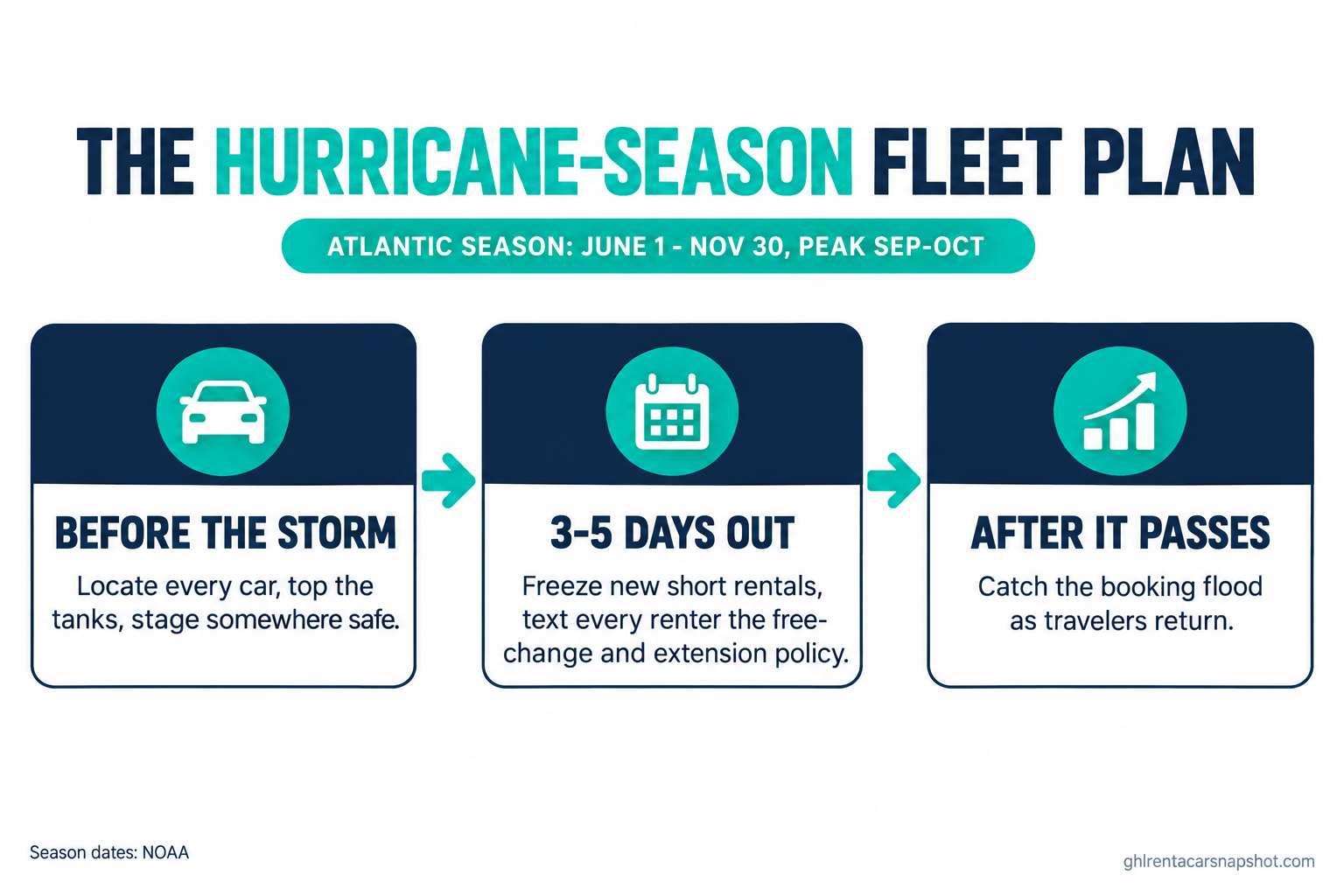
Think of it in three moves. Well before any storm, protect the fleet: know where every car is, keep tanks topped on anything not rented, and pick a safe staging location in advance. When a system is three to five days out, freeze new short rentals in the impact window, decide whether you rent for evacuation at all, and message every active renter with your return and extension policy. After it passes, demand does not just resume, it floods, because everyone who left needs a car and everyone whose plans slipped is rebooking. The operator who kept the fleet safe and customers informed catches that rebound.
Because this is also the slow leisure stretch, do not let the lot go fully idle. An idle car is not neutral, it is a loss. A rental vehicle averaged about $1,387 a month in revenue in 2024 per Geotab, and a parked car forgoes most of that while still depreciating, insured, and financed. Fill the quiet weeks the way you would any trough: weekly and monthly rates for locals and insurance-replacement drivers, offers to past renters, and a tight waitlist so cancellations get backfilled fast. The full trough playbook is in the car rental slow season guide, and the backfill mechanics are in the waitlist and re-rent system.
Where summer breaks: going dark during a storm. Silence turns a weather event into a pile of chargebacks and angry reviews. If a renter cannot reach you to extend or change, they dispute the charge or they panic, and either way you lose. The storm is not what hurts your business. Not having an automated, pre-written way to reach everyone at once is.
Season 4: The early-fall rebuild (late September to October)
As the peak storm weeks pass and the calendar turns toward the holidays, your job shifts to rebuilding the pipeline before the winter rush lands. This quiet season decides how strong your November looks. Operators who treat October as a dead month scramble for bookings in December. Those who use it to warm up their list have a full lot before Thanksgiving.
Spend early fall reactivating. Every past renter in your database is a warm lead for winter, and a simple, well-timed message wins back a share of them for the price of a text. Get maintenance and detailing done while utilization is low, and make sure your booking page, reviews, and rates are ready for the traffic that returns with the cool weather. Push for the reviews you earned over the summer too, because a strong review profile going into winter is what wins the comparison when a tourist is choosing between you and the airport counter.
Three scenarios: solo, mid-size, large fleet
The calendar is the same across the city. What you do about it depends on your size, because the constraint changes.
Solo or small (5 to 12 cars). Your bottleneck is you. In winter you are the counter, the cleaner, and the phone, so your whole edge is automation that answers when you cannot. Get missed-call text-back and an automated booking reply running before the November rush, and keep your storm plan dead simple: one broadcast list, one pre-written text, one safe place to stage the cars. You cannot afford a storm week of silence, and you cannot afford to personally answer a winter weekend of calls either. Let the system cover both.
Mid-size (20 to 40 cars). Now you have staff and a real fleet, so your problem is consistency and coordination. Everyone needs to work from one availability view, your event-weekend rules need to apply the same way whether you are there or not, and your storm plan needs defined roles, who moves cars, who messages renters, who handles the rebound. This is the size where a double-booking in winter or a communication gap in a storm costs real money, so the automation is less about saving your personal time and more about making sure the business runs the same on your best and worst days.
Large (60 to 100 cars). At this scale seasonality is a balance-sheet problem. The spread between a 90% winter and a soft August is the difference between a strong year and a scary one, so your job is demand-smoothing: weekly and monthly contracts and corporate accounts that hold through the summer, dynamic pricing that captures every dollar of the winter peak, and a utilization number you watch like a hawk. A single point of fleet utilization across 80 cars is a lot of money, and the storm plan here is a genuine logistics operation, not a group text.
The Florida compliance layer most operators miss
Every text in this post is a marketing message to a phone, and Florida is one of the least forgiving states in the country for getting that wrong. The Florida Telephone Solicitation Act (FTSA), the state’s mini-TCPA, carries a private right of action, which means a renter, or a lawyer trolling for them, can sue you directly. A 2023 amendment (HB 761) narrowed the law and added a safe harbor: before anyone can sue over a solicitation text, they have to reply STOP, and you then have 15 days to stop. Honor opt-outs instantly and that safe harbor protects you. Ignore one and the statute allows damages of $500 per violation, up to $1,500 if willful.
On top of the state law, your texting has to clear federal rules. You must register your brand and campaign through A2P 10DLC before you send business texts at volume, and campaign registration now has to carry a privacy-policy URL and a terms-and-conditions URL. One thing to be clear about: there is no one-to-one consent rule in force. The FCC rule that would have required separate consent for each individual sender was vacated in January 2025, so do not let a vendor scare you into a workflow built around a rule that no longer exists. Get consent properly, keep clean opt-in records, honor STOP, and you are on solid ground. The full build is in texting rental reminders without a TCPA or 10DLC disaster.
Common objections, answered
“I’ve run this lot for years without a seasonal plan. Why now?” Because the market got more competitive and the fees got higher, so the margin for being reactive shrank. A seasonal plan is not extra work, it is the same work scheduled instead of improvised. You already know winter is busy and summer is slow. Writing it down means you stop being surprised by what happens every year, and you stop leaving winter money on the table because you were too busy to answer.
“Isn’t a storm plan overkill for a small lot?” The opposite. A big fleet has staff to absorb a chaotic week. You do not. For a solo operator, a storm with no plan is the most likely way to lose a month of bookings and pick up a stack of chargebacks at once. The plan is not complicated: one list, one pre-written message, and one decision about where the cars go, made in advance. A morning of work that protects your worst week of the year.
“Won’t customers be annoyed by all these automated texts?” Only if the texts are useless. Nobody minds a storm update that lets them change a booking for free, or a missed-call reply that gets them a quote in two minutes. People get annoyed by generic blasts, not by a message that answers the question they have right now. Send fewer, better, timelier texts and opt-outs stay near zero.
“I already use booking software. Doesn’t it handle this?” Booking software handles the reservation. It does not answer your missed calls, run your storm broadcast, reactivate last winter’s renters, or chase the review after a good return. Those are marketing and communication jobs that most rental software leaves to you. That gap is what a GoHighLevel build fills, sitting alongside your booking tool rather than replacing it.
Frequently asked questions
When is the busy season for car rental in Miami?
Miami's high season runs roughly November through April, driven by snowbirds, holiday travelers, and a packed events calendar including Art Basel in December. Greater Miami drew a record 28 million visitors in 2024, and that demand concentrates in the cool, dry winter months. Spring break in March and the Formula 1 Miami Grand Prix in May add sharp, datable demand spikes on top of the winter base.
What fees do car rental companies charge at Miami airport?
On-airport pickups at MIA carry a Customer Facility Charge of about $5.35 a day per DWU Consulting's fee tables, plus a concession recovery fee commonly cited around 10% of the rental. Florida also imposes a $2-per-day surcharge under Fla. Stat. 212.0606 on the first 30 days, though that surcharge is exempt at airport-operated locations. An off-airport lot skips the concession and facility fees, which is why off-airport quotes near MIA often come in meaningfully lower.
How should a Miami car rental business handle hurricane season?
Treat June 1 through November 30 as a planned operational season, not a surprise. Before any storm, know where every car is and keep a safe staging location ready. When a system is three to five days out, freeze new short rentals in the impact window and message every active renter with your extension and change policy. After it passes, be ready for a booking flood as travelers return. The biggest risk is going silent on communication, which turns a weather event into chargebacks and bad reviews.
Is the $2 Florida rental surcharge charged at the airport?
No. Florida's $2-per-day surcharge under Fla. Stat. 212.0606 does not apply to rentals from locations owned or operated by an airport authority, and it applies only to the first 30 days of a rental. Off-airport operators do collect it. The on-airport brands instead carry their own concession and facility-fee structure, so the two location types have different fee stacks.
Can I legally text booking and storm updates to renters in Florida?
Yes, with proper consent and clean records. Florida's Telephone Solicitation Act (FTSA) carries a private right of action, so honor STOP requests immediately (the 2023 HB 761 amendment gives you 15 days to stop and acts as a safe harbor). You also need A2P 10DLC brand and campaign registration, with privacy-policy and terms URLs on the campaign. There is no one-to-one consent rule in effect; that FCC rule was vacated in January 2025. Transactional updates to active renters are lower risk than cold marketing blasts.
How much does an idle rental car cost during the slow season?
More than operators think. A rental vehicle averaged about $1,387 a month in revenue in 2024 per Geotab, so a car parked through a slow August forgoes roughly that much in revenue, on top of continued depreciation, insurance, and financing. That is why the summer trough is worth attacking with weekly and monthly rates, past-renter offers, and a waitlist that backfills cancellations, rather than simply waiting it out.
It is December again, and the phone is lighting up on an Art Basel Friday. This time the missed calls get an instant text back, the busy weekend gets your real rate, the one storm that formed in September cost you a careful week instead of a brutal month, and last winter’s renters are already rebooked because you reached out in October. The Miami calendar did not change. What changed is that you stopped treating a predictable year as a series of surprises.
If you want the whole system, missed-call text-back, dynamic winter pricing, storm-season broadcasts, waitlist backfill, and review capture, built for rental lots and installed in your account in 24 hours, it lives in the Car Rental Snapshot. Spend thirty minutes on a walkthrough before the next season turns.