
It is Tuesday morning and a renter you turned down on Friday just rebooked a competitor. You told her the Tahoe was gone that weekend, said sorry, and moved on. What you did not see: the Friday booking that took the Tahoe cancelled Saturday night. The car sat on your lot all weekend while a renter who wanted it, card ready, drove something else. You did not lose that rental to price or to Turo. You lost it because nothing connected a cancelled slot to the person who would have filled it.
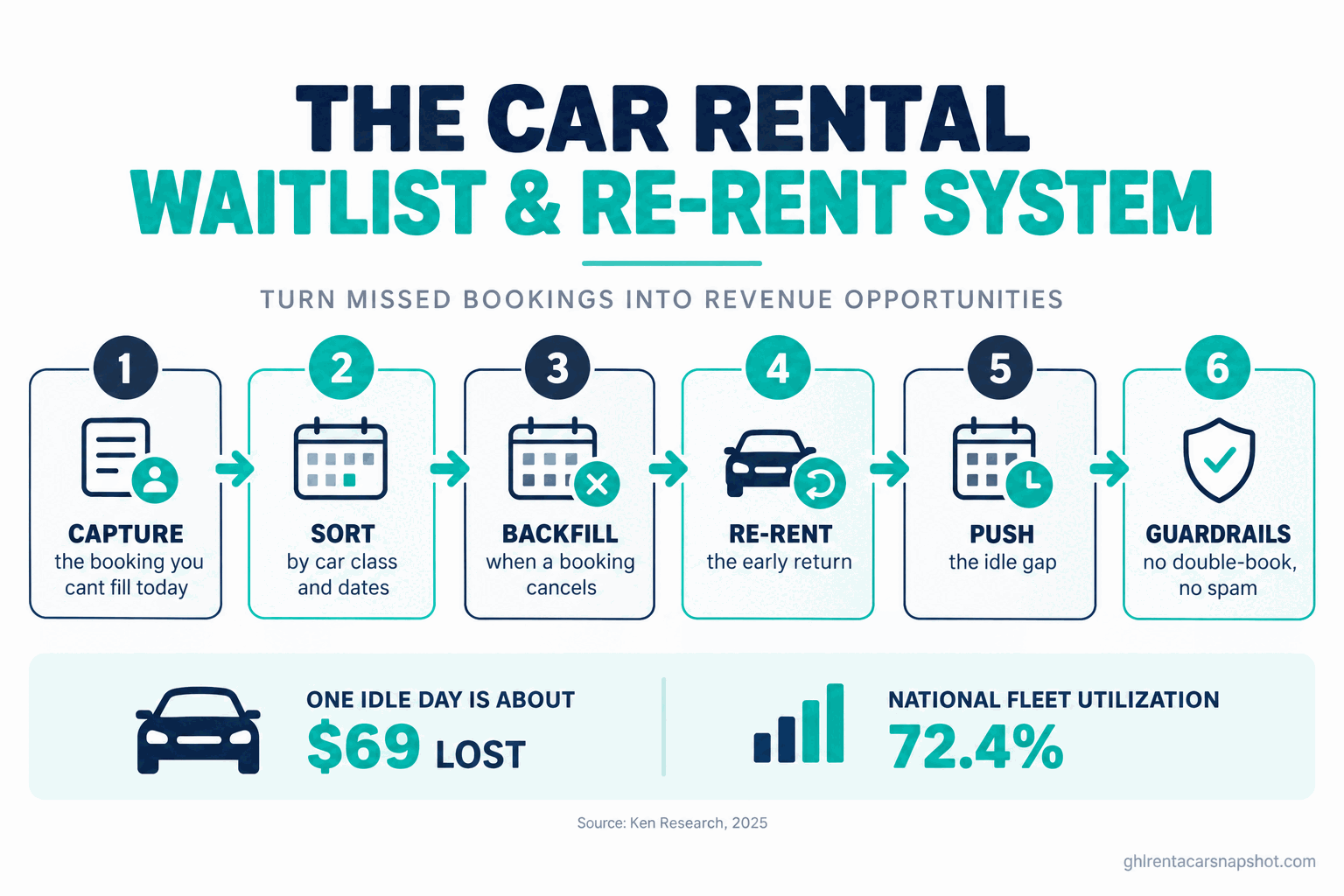
Here is the short version so you can fix it this week. Every cancelled booking, no-show, and empty midweek day is a car earning nothing, and most lots have no system to refill that gap before it is gone. The fix is a waitlist you actually capture and a re-rent trigger that fires the moment a slot opens: when someone asks for a car you can’t give them today, you tag the request by class and date instead of saying sorry, and when a booking cancels or a car returns early, the system texts the matching people automatically. It runs on tags and triggers, not on you remembering who wanted what.
Key Takeaways
- An idle car day is worth about $69 you can’t get back. US car rental revenue runs near $69.45 per rental day (Ken Research), so every cancelled weekend and empty midweek slot is money gone, not deferred.
- The majors run high-70s utilization; most independents do not. National fleet utilization sits around 72.4% and Hertz hit 79% in Q1 2025 (Hertz 8-K). The gap between 60% and 72% on a 20-car fleet is roughly $63,000 a year.
- The waitlist is the asset. A tagged list of people who wanted a car you couldn’t give them is the fastest, cheapest demand you own. The re-rent trigger turns a cancellation from a loss into a text.
Table of contents
- What an idle car actually costs you
- The waitlist and re-rent system, start to finish
- Stage 1: Capture the booking you can’t fill today
- Stage 2: Sort the waitlist by car class and date
- Stage 3: Backfill the second a booking cancels
- Stage 4: Re-rent the car that comes back early
- Stage 5: Push the idle gap before it happens
- Stage 6: Guardrails so you never double-book or spam
- The same system at 3, 20, and 80 cars
- Texting a car just opened without a TCPA problem
- Steal these: the waitlist and re-rent scripts
- Common objections, answered
- Frequently asked questions
What an idle car actually costs you
A car on your lot with no renter in it is not resting. It is depreciating, insured, financed, and earning zero. Rental revenue is perishable like an airline seat: the Tuesday you did not rent the Camry is gone forever.
Put a number on it. US car rental revenue runs about $69.45 per rental day (Ken Research), and the industry crossed $40.6 billion in projected 2025 revenue at roughly $1,379 per unit per month, down from $1,427 the year before (Auto Rental News, 2026 Fact Book). So one idle day on one car is about $69 you will never recover.
The gap is not theoretical. National fleet utilization sits near 72.4% for 2025 (Ken Research), while Hertz reported 79% in the first quarter of 2025, up 240 basis points from a year earlier (Hertz 8-K). The majors sweat the fleet because they know what you are about to see on your own lot.
Run the math on a 20-car fleet. At $69.45 per rental day, a car that rents 60% of the year brings in about $15,200; at 72%, about $18,250. Across 20 cars, moving from 60% to 72% is roughly $63,000 a year, and almost none of it requires new leads. It requires filling slots you already created and then lost. That is what a waitlist and a re-rent trigger do. Our fleet utilization rate guide shows how to calculate the number for your own lot.
Illustrative annual revenue for a 20-car fleet at different utilization levels, using $69.45 revenue per rental day over 365 days. Revenue-per-day input: Ken Research. Figures are illustrative, not a promise of results.
The waitlist and re-rent system, start to finish
Six stages, each closing one place where a rentable day leaks. The whole thing runs on two ideas: capture the demand you can’t serve today so it does not walk, and fire a trigger the instant supply opens up so the gap refills before anyone notices it was there.
You do not need a new platform. If you already run bookings and contacts in GoHighLevel, the pieces are tags (what car class and dates someone wanted), a pipeline stage (Waitlist), and workflows that watch booking status. The build works whether your booking system is a real calendar or a shared spreadsheet, as long as a cancellation or early return can trigger a notification.
Stage 1: Capture the booking you can’t fill today
The moment a renter asks for a car you don’t have free, you are standing on your most valuable lead of the week: someone with a specific need and a date, ready to pay, and you are about to say “sorry, we’re booked” and let them leave. That is the single biggest leak in an independent lot.
Replace “sorry” with a capture. Whether the request comes by phone, text, Instagram DM, or your website form, the answer is the same: “That one’s booked for those dates, but cancellations happen on almost every weekend. Want me to put you on the list and text you the second it frees up?” Almost everyone says yes, because it costs them nothing and they were going to keep shopping anyway.
Mechanically, you create or update the contact, drop them into a Waitlist pipeline stage, and tag the request: one tag for the car class, one for the date range. That is the entire capture, and if every channel lands in one place it is a five-second action. If yours do not yet, our one-inbox lead system guide is the prerequisite.
Stage 2: Sort the waitlist by car class and date
A waitlist you can’t filter is just a pile. The point of tagging in Stage 1 is that when a slot opens, you can pull exactly the people who wanted that class on those dates in one click, instead of blasting your whole list and annoying the 90% it does not fit.
Keep the taxonomy simple. Tag by the thing renters ask for: economy, SUV, luxury, van, exotic, whatever your real classes are. Tag the dates they wanted as a start and end, or at minimum the weekend. If someone is flexible (“anything that seats seven that weekend”), tag the class loosely and the date tightly, because date is the hard constraint and class is the soft one.
This is the same tag-and-trigger plumbing that powers a repeat-renter loyalty flywheel: the list is only worth your ability to segment it. Set it up so a workflow can answer one question instantly: who wanted a car like this, for dates like these?
Stage 3: Backfill the second a booking cancels
This is the stage that pays for the whole system. A booking cancels or no-shows, and today that just quietly becomes an idle car. Instead, the cancellation becomes a trigger.
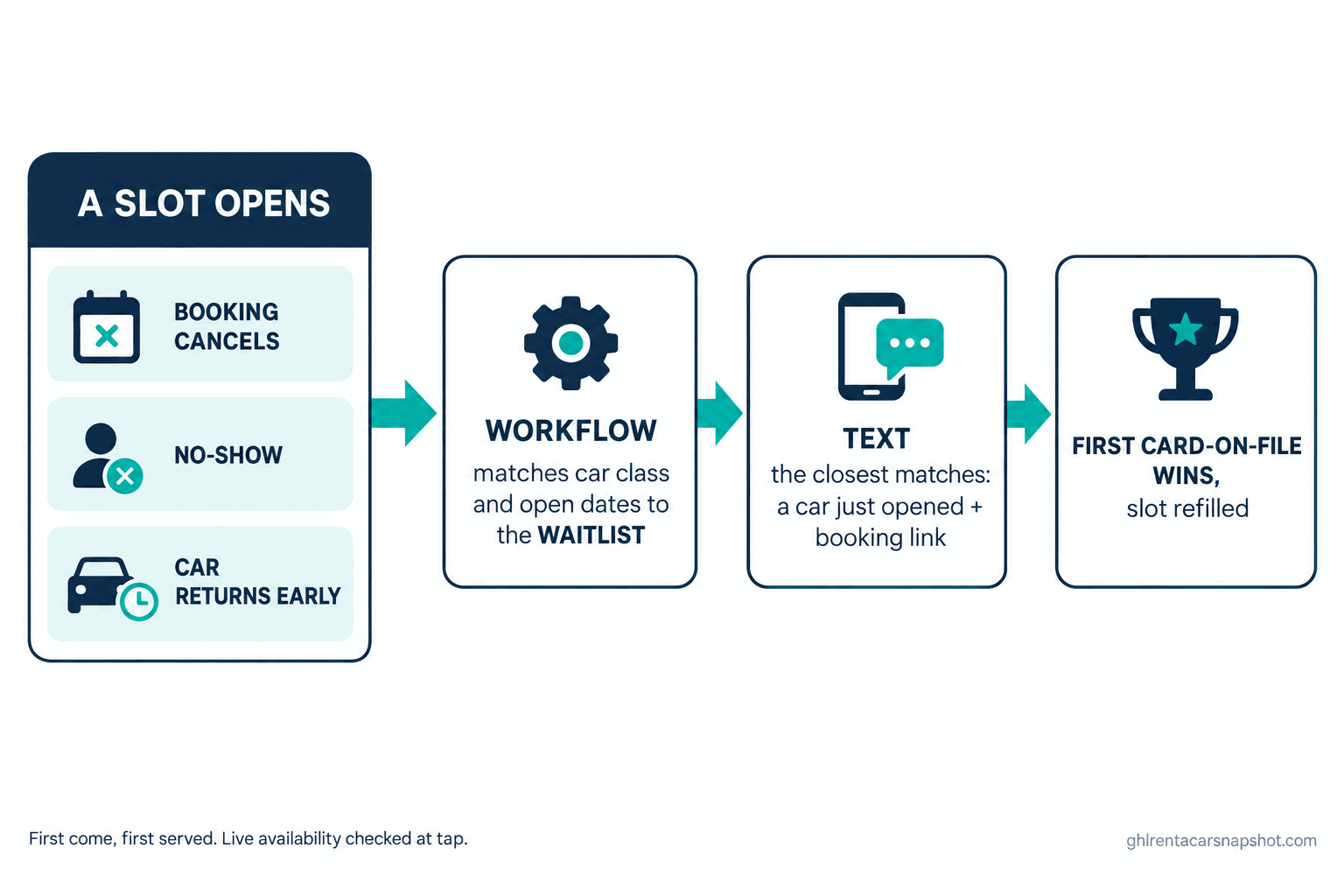
Build it like this: when a reservation moves to Cancelled or No-show, a workflow reads the car class and now-open dates, finds every waitlist contact tagged for that class and an overlapping range, and sends a short “a car just opened up” text with a booking link. First to tap and put a card down takes the slot; the workflow tags the rest “slot filled” so nobody shows up to a car that is gone.
No-shows feed the same machine. A no-show is a cancellation that told you late, and the recovery logic for both is covered in our no-show and cancellation recovery guide. The difference a waitlist makes: instead of hoping the original renter comes back, you already have three other people who wanted that exact car.
Stage 4: Re-rent the car that comes back early
Cars come back early more than operators plan for. A trip gets cut short, a corporate renter wraps a day ahead, weather changes plans. That car now sits with an unexpected open day or two before its next booking, pure idle time you did not forecast.
Wire the return event to the same demand. When a car is checked in earlier than its scheduled return, a workflow flags the freed dates and pings the waitlist for that class, plus anyone who recently asked about a same-day rental. The window is short, so a small nudge helps: “just came back early, yours tonight if you want it.” The urgency is real, so it does not read as a gimmick.
This is also where channel sync matters. If the same car is listed on Turo and your direct site, an early return has to update everywhere at once, or you re-rent a car your marketplace still shows as out. That is its own discipline, covered in stop double-booking across Turo and your website. Do not run the re-rent trigger until your calendars agree.
Stage 5: Push the idle gap before it happens
The first four stages react to a gap. This one gets ahead of it. Your calendar already shows empty days 48 or 72 hours out, so a car with an open midweek stretch does not have to wait for a cancellation to get noticed.
Run a daily workflow that scans the next few days for cars with open gaps and either promotes them to the matching waitlist or sends a targeted last-minute offer to warm leads for that class. A modest midweek rate on a car that would otherwise earn zero beats the zero, as long as you protect your peak dates (see the guardrails next). This pairs with the broader approach in our slow-season playbook.
Stage 6: Guardrails so you never double-book or spam
A re-rent system that fills slots fast is only safe if two guardrails hold. First, overbooking protection: the booking link in every backfill text must check live availability at the moment of tap, not of send. If two people both click, only the first card-on-file wins, and the second sees “just taken” rather than a confirmed double-booking. Tie the link to real-time calendar state so a race never becomes a conflict at the counter.
Second, message discipline. The waitlist texts are still automated messages to a list, so they live under the same consent, 10DLC, and state rules as any other outbound text. That is the next section, and it is not optional. Skip it and a system meant to make money becomes a liability.
The same system at 3, 20, and 80 cars
The framework does not change with fleet size, but what you automate and how hard you push does.
Solo operator, 3 to 5 cars. You are the system. The waitlist can be a tagged list in your contacts, and the backfill is you texting two or three people when a slot opens. The win here is pure discipline: capturing every “we’re booked” into a list instead of saying sorry. One refilled weekend a month on a five-car lot is real money. Keep the triggers manual; you need the habit, not workflows yet.
Mid-size, around 20 cars. This is where the manual version falls apart and automation pays for itself. You cannot track who wanted what across 20 cars in your head, and cancellations happen weekly. Build the real version: tags by class and date, a Waitlist stage, and workflows that fire on cancelled, no-show, and early-return statuses. At 20 cars the $63,000 utilization gap between 60% and 72% is your biggest, cheapest growth lever.
Large, 60 to 80 cars. Now the risk flips from forgetting to spamming. The Stage 3 discipline (closest matches first, cap the blast) and the Stage 6 overbooking guardrail become load-bearing. You also segment by value: corporate and repeat renters get the slot first, bargain hunters last. The automation is the same; the prioritization is what separates a fleet that fills gaps profitably from one that just discounts them away.
Texting a car just opened without a TCPA problem
Every message in this system goes to a list on a schedule, which makes it automated outbound texting, which means the TCPA, A2P 10DLC registration, and state mini-TCPA laws all apply. Get this right once and it runs clean; get it wrong and the same automation that fills slots generates complaints and, in some states, lawsuits.
Start with consent. You need prior express consent to text, and the cleanest version is the renter opting in when they join the waitlist (Stage 1 is the natural place to get it). Worth knowing: the FCC’s “one-to-one consent” rule, which would have tightened this further, was vacated by the Eleventh Circuit in January 2025, so it does not apply (National Law Review). Standard prior express consent is the bar, not consent “plus.”
Register your campaign. US carriers require A2P 10DLC brand and campaign registration for business texting, and as of June 30, 2026, new registrations must include a public PrivacyPolicyUrl and TermsAndConditionsUrl (Twilio). Have both live before you register. Then mind state law: Florida’s mini-TCPA, the FTSA, carries a private right of action, though a 2023 amendment added a 15-day notice-and-cure window for text claims and tightened what counts (Manatt). Honor a “stop” immediately and you stay clear. The full build is in texting pickup and return reminders without a TCPA or 10DLC disaster.
Steal these: the waitlist and re-rent scripts
Copy these, swap in your lot name and cars, and keep every message short with a clear opt-out on the first one. These are templates, not legal advice; confirm consent and your 10DLC registration first.
The capture reply (when you have to say no).
“That one’s booked for your dates, but cancellations happen most weekends. Want me to add you to the waitlist and text you the second it opens? Reply YES and I’ll tag it. Msg&data rates may apply, reply STOP to opt out.”
The cancellation backfill text.
“[Lot name] here. Good news: a [SUV] just opened for [Fri 11/14 to Sun 11/16], the dates you wanted. First to grab it keeps it: [booking link]. Reply STOP to opt out.”
The early-return same-day re-rent.
“A [Civic] just came back early, so it’s free tonight through [Thu]. Yours if you want it: [booking link]. Reply STOP to opt out.”
The idle-gap offer (midweek, tied to one car).
“Midweek opening: the [Civic] is free [Wed to Fri], $10/day off those dates only. Grab it here: [booking link]. Offer ends when the gap fills. Reply STOP to opt out.”
The front-desk phone script (turning a no into a waitlist add).
“I don’t have that one free for your dates, but I’ll be honest, cancellations happen on almost every weekend. If you give me your number, I’ll text you the minute it opens and you’ll be first in line. No cost, no obligation. Sound good?”
Telling renters “cancellations happen most weekends” is true, and it makes the ask land. You are not promising a car; you are offering a free shot at one they already wanted, so a spot on your list is pure upside to them. That is why the capture rate on this is high.
Common objections, answered
“Won’t last-minute discounts just train renters to wait for a deal?” They would if the discount were standing and fleet-wide. Tie it to a specific open gap on a specific car with an expiry, and it does the opposite: renters learn that deals are rare, tied to luck, and gone fast. Your peak dates stay full price because the offer never touches them. You are clearing dead inventory, not running a sale.
“I already pay for Fleetwire or HQ Rental Software, doesn’t it handle this?” Most booking software manages the calendar and the reservation, but a managed calendar does not, on its own, capture the people you turned away or text them when a slot frees. The waitlist and re-rent trigger are a layer on top of whatever runs your bookings. If your tool exposes cancellation and return events, you wire the triggers to it; if not, that is a reason to look at a system that does, the case we make in off-the-shelf versus a system built around your workflow.
“Isn’t a waitlist just more work for me?” The capture is five seconds on an inquiry you were already handling. After that it works while you sleep: a cancellation at 11pm fires the text, someone books overnight, and you find a filled slot in the morning. The work is in the setup, once, and the payoff repeats on every cancellation. If nobody bites, you are where you would have been anyway, with an open car, except now you also have a Stage 5 gap offer. The waitlist only ever adds options.
Frequently asked questions
What is a car rental waitlist and how is it different from a booking calendar?
A booking calendar tracks reservations you already have. A waitlist tracks the demand you couldn't serve: renters who wanted a car that was booked for their dates. When a slot opens through a cancellation, no-show, or early return, the waitlist tells you exactly who to text, so the gap refills instead of sitting idle.
How much revenue does an idle rental car actually lose?
US car rental revenue runs about $69.45 per rental day (Ken Research), so one idle day on one car is roughly $69 you can't recover. Across a 20-car fleet, moving utilization from 60% to the national 72.4% average is about $63,000 a year, almost all from refilling slots you already created.
Is it legal to text people when a car becomes available?
Yes, with consent and registration. You need prior express consent (the waitlist opt-in is the place to get it), A2P 10DLC registration, and from June 30, 2026 a public privacy policy and terms URL on the registration (Twilio). Honor opt-outs immediately. The FCC's one-to-one consent rule was vacated in January 2025, so it does not apply (National Law Review).
How do I stop the backfill text from double-booking a car?
Make the booking link check live availability at the moment of tap, not of send. If two matched renters both click, the first card-on-file wins and the second sees it was just taken. Sync every channel first, as covered in keeping one fleet in sync.
Do I need special software to run a waitlist and re-rent system?
No new platform if you already run contacts and bookings in a CRM like GoHighLevel. You need three things: tags for car class and dates, a Waitlist pipeline stage, and workflows that fire on cancelled, no-show, and early-return statuses. A solo operator can run the capture manually; the automation matters most around 20 cars and up.
The renter who rebooked a competitor on Tuesday was never a pricing problem. She was a systems problem: you had the demand and you had the car, and nothing connected them when the slot opened. Build the capture so you stop saying sorry, wire the triggers so cancellations and early returns text the right people on their own, keep the guardrails so it never double-books or spams, and the cheapest growth on your lot stops walking out the door.