
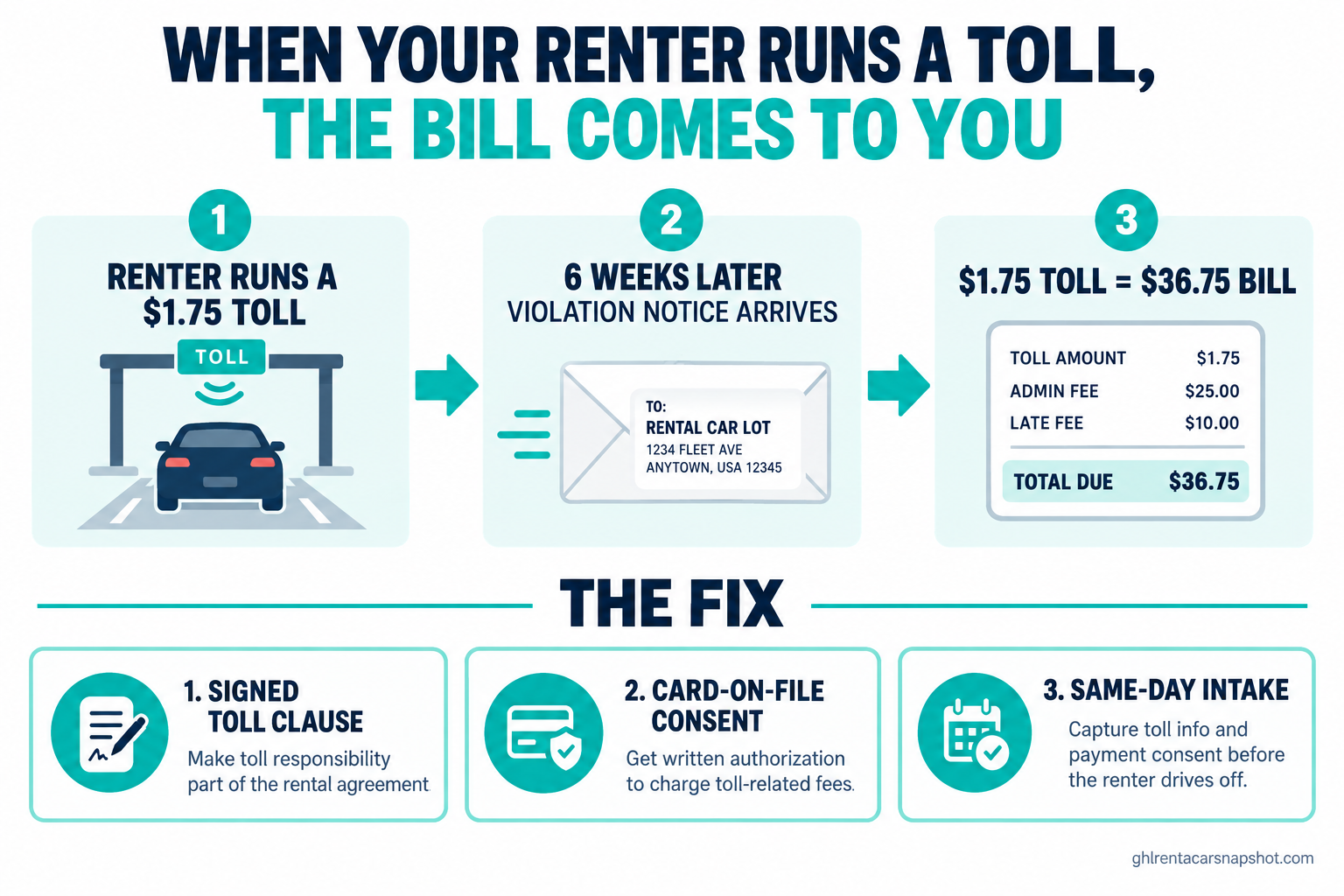
It is a Tuesday six weeks after the rental closed. You open the mail and there is a toll violation notice with your lot’s name on it, because your name is on the registration. The renter is long gone, their deposit hold released, and a late penalty is stacked on a toll that started life as $1.75. You can eat it, or go chase a renter who returned the car clean and never mentioned a toll road. Most lots eat it. That is the leak.
Here is the short answer. You are the registered owner, so every toll and camera ticket comes to you first, but the renter is liable, and the only way to collect is to decide the money part before the keys leave: a toll-and-citation clause they sign, a card you are allowed to charge after return, and a workflow that catches the notice the day it lands. Do that and a $1.75 toll stops costing you $45.
Key Takeaways
- The notice comes to you because you own the car. A toll authority or municipality bills the registered owner, your lot, and it can take one to four weeks or longer to arrive (Alamo).
- The renter is liable, but only if your paperwork says so. A signed toll-and-citation clause plus card-on-file consent turns “we ate it” into “we collected it.”
- The big brands treat this as a profit center. Avis charges about $20 per ticket on top of the fine (SlashGear); daily toll programs run roughly $4 to $7 (One Mile at a Time).
Table of contents
- The 60-second answer
- What unpaid tolls and tickets cost you
- The core idea: you are the bridge
- The pass-through system, stage by stage
- What the big brands charge
- Steal these: the messages that collect
- Same problem, three fleet sizes
- The texting and billing rules that bite
- Objections, answered
- FAQ
The 60-second answer
Every toll and camera ticket your cars collect comes to your lot, because your lot is the registered owner, but the renter who ran the toll owes it, and federal law backs the idea that you are not liable for their driving just because you own the car (Lewis Brisbois on the Graves Amendment). The catch: that only helps if a clause, card-on-file consent, and a same-day intake routine are in place before the keys leave. Miss any one and you are paying a stranger’s toll.
What unpaid tolls and tickets cost you
The sticker on a toll is tiny. The cost is everything that stacks on top of it.
The problem is timing. When a renter runs a cashless toll or trips a camera, the authority bills the registered owner, and that is slow: Alamo tells its own customers it usually takes one to four weeks, sometimes longer, to receive the information (Alamo). By then the rental is closed, the hold is released, and a $1.75 toll with a $35 penalty is a $36.75 problem you cannot pin on anyone, dozens of times a month in a tolled metro.
The national brands do not absorb this; they monetize it. Avis applies about a $20 fee per ticket on top of the fine (SlashGear), and toll programs run roughly $4 to $7 a day (One Mile at a Time). A Kyte co-founder said it out loud: “historically, tolls have been a profit center for car rental companies.” They can, because Enterprise, Hertz, and Avis plug into a processor like Verra Mobility that ingests tolls and violations across the whole fleet automatically (Verra Mobility). You do not have that, so the independent default is to pay and forget to bill the renter. For lots already bleeding on chargebacks and friendly fraud, the toll leak is the quiet cousin: smaller per hit, constant, and fully recoverable.
The core idea: you are the bridge
Get this mental model right and the rest follows. You are not the party who should pay the toll. You are the bridge between the authority that issued it and the renter who earned it: receive the notice, identify the renter, move the cost to them with a trail that survives a dispute.
Two legal ideas do the work. The renter is contractually responsible for what happens while they have the car, so your agreement has to say so. And in many states you can transfer liability by giving the authority the renter’s name and address (Enterprise, via SlashGear); where you cannot, you pay and bill under your contract. The Graves Amendment keeps you from being vicariously liable for a renter’s negligence just because you own the vehicle, but it does not stop notices arriving at your address, and it is no substitute for a clause (Lewis Brisbois).
The pass-through system, stage by stage
Six stages, start to finish. Each has a setup and a way it breaks.
Stage 1: Write the clause that makes it enforceable
Everything rests on one paragraph. It has to say three things: the renter is responsible for all tolls, parking tickets, camera citations, and related fines during the rental; the renter authorizes you to charge the card on file for those amounts plus a stated administrative fee; and you may give the renter’s information to enforcement authorities. Name a specific fee, say $25 per citation, so nobody argues later about “reasonable.” No clause yet? Start with our rental agreement clauses that actually protect you and add the toll language.
Where it breaks: a vague “renter is responsible for fees” with no card authorization and no named fee. When the renter disputes, your processor asks for the authorization, and “it was implied” loses.
Stage 2: Decide your toll strategy on purpose
You have three honest options: hand the renter a transponder and bill actual tolls plus an admin fee; run no transponder, let cashless tolls bill to your plate, and pass them through when the notice lands; or charge a flat daily toll fee like the majors. Most independents running 10 to 40 cars should run pass-through: no hardware, and it fits how cashless tolling already works, with the one to four week billing delay as the tradeoff.
Where it breaks: doing nothing and discovering your metro went all-electronic, so every toll becomes a plate-based notice weeks later. Near all-electronic roads, pick transponders or a rock-solid intake routine. Decide, do not drift into it.
Stage 3: Capture card-on-file consent you can use after return
The system dies if you cannot charge the card once the rental closes. That is different from the deposit hold, a pre-authorization you release on a clean return. You need standing consent to charge the same card for incidentals, tolls and citations included, that surface after the car is back. If deposits are shaky, fix that first with automating security deposit holds without chasing cards.
Where it breaks: treating the hold as the thing that pays the toll. Holds expire in days, long before a notice arrives, so that authorization is gone when you need it. Capture separate, durable consent for post-return incidentals and log how the renter agreed.
Stage 4: Intake the violation the day it lands
This is the stage independents skip and the majors automate. A notice has to trigger a task immediately: match it to the vehicle and rental dates by the date, time, and plate it carries, identify the renter, and open a pass-through record. In a CRM that is a pipeline stage with a tagged contact and a due date, not a sticky note on the printer.
Where it breaks: the notice sits in a pile. Every day it waits the penalty grows and a missed appeal window can turn a transferable notice into one you are stuck with. Make intake same-day, the same discipline that keeps your one-inbox lead response from dropping bookings.
Stage 5: Notify and bill with the evidence attached
Now move the money. Send the renter a clear note: the toll or citation, the date and vehicle, the amount plus the administrative fee from your agreement, and when you will charge the card. Attach the notice itself. Transparency here is chargeback defense: a renter who sees the actual citation with a matching date rarely disputes; one who sees a surprise line item does.
Where it breaks: charging first and explaining never. A silent $45 charge six weeks out is the textbook dispute trigger, and you lose it without documentation. Notify before you charge, and keep the exchange in writing.
Stage 6: Collect, transfer where you can, and defend the dispute
Close it out. Charge the card under the consent you captured, or, where your state allows, transfer liability by sending the renter’s name and address to the authority (Washington is one transfer-by-notice example). Either way, archive the signed clause, the consent, the notice, and your message together. If the renter disputes anyway, that bundle wins it, the same evidence habit that protects your deposits against disputes.
Where it breaks: no archive. Six months later the chargeback lands and you cannot find the agreement or the notice. Store every pass-through as a complete record, so defending it is a two-minute export.
What the big brands charge
You are not inventing pass-through. The national brands have run it for years, and their published fees show how real the money is.
Reported fees in USD. Alamo TollPass about $4.95/day capped near $34.65, and Avis about $20 per ticket processed, per SlashGear; daily toll-program ranges per One Mile at a Time. Confirm current numbers on each vendor’s page.
Here is how the three strategies line up:
| Toll strategy | Hardware | When you collect | Best for |
|---|---|---|---|
| Transponder + actual tolls | Yes, per car | After return, fast | Heavily tolled metros, higher-mileage renters |
| Pass-through on plate notices | None | 1-4 weeks later | Most 10-40 car independents |
| Flat daily toll fee | None | At booking | Lots wanting simple, disclosed pricing |
You can charge a modest, disclosed admin fee too, as long as your agreement names it. You just build the intake.
Steal these: the messages that collect
Here is the copy that does the work. Keep these transactional: they are about a specific charge tied to a specific rental, which is why they are lower risk than marketing. You still need the Stage 3 consent.
The toll pass-through notice (email or text, transactional):
Hi [first name], a toll from your rental of the [vehicle] on [date] came through to us as the registered owner. The toll was [$ amount], plus our [$ amount] admin fee per the rental agreement you signed. We’ll charge the card on file ending [last 4] on [date, at least 3 days out]. The toll notice is attached. Reply if anything looks off and we’ll sort it before we charge.
The citation notice (email, transactional, attach the ticket):
Subject: Citation from your [date] rental, action needed
Hi [first name], we received a [type] citation for the [vehicle] you rented on [date]. Because our lot is the registered owner, it came to us first, but under your rental agreement the citation is your responsibility. The fine is [$ amount] and our admin fee is [$ amount]. You can pay the issuing authority directly at [link] by [date], or we’ll charge your card on file on [date]. The citation is attached. Questions? Reply here.
The dispute response (email, when a renter pushes back):
Hi [first name], I understand the surprise. Attached are three things: the rental agreement you signed on [date] with the toll-and-citation clause highlighted, the authorization for charges to your card, and the official notice we received for the [date] toll on the [vehicle]. The date and plate match your rental window. If you believe the toll itself is an error, the issuing authority handles that at [link]. Happy to walk through any of it.
That dispute response is the difference between winning and losing a chargeback: it never argues, it attaches. More in why chargebacks keep draining your account.
Same problem, three fleet sizes
The right version scales with your lot. Same six stages, three builds.
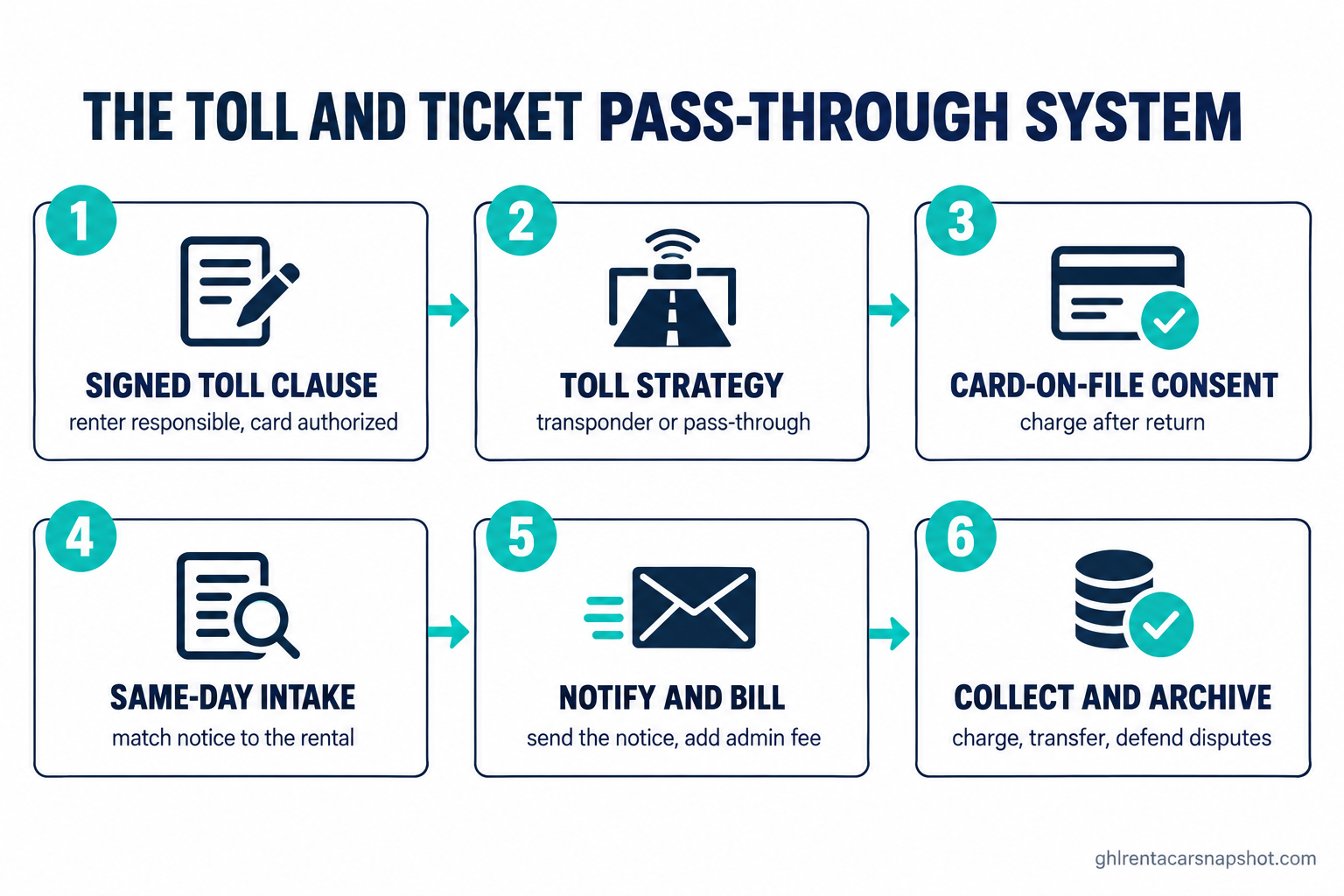
Solo operator, 5 to 12 cars. Keep it lean: a signed agreement with the toll clause, a card-on-file consent box, and a calendar block twice a week to process whatever notices arrived. You can still match a notice to a rental from your booking log, so skip transponders. Your only real risk is letting notices pile up.
Mid-size shop, 20 to 40 cars. Manual matching starts to fail and the leak gets expensive. Move intake into your CRM as a real pipeline: a notice creates a tagged record, auto-matches to the active rental by date and plate, and queues the notification. At this volume you field dozens of notices a month, the admin fee stops being rounding, and a missed appeal deadline costs real money, so same-day intake is non-negotiable.
Large fleet, 50-plus cars. Now you are in the majors’ world: either contract a processor like Verra Mobility or run a tight internal system that mirrors it, with centralized intake, automatic matching, and an archive that survives an audit. The toll leak is now a budget line, and the admin-fee revenue a genuine contributor.
What stays constant at every size: the notice comes to you, the renter owes it, and only your paperwork and your intake routine decide whether you collect.
The texting and billing rules that bite
Collecting a toll is a billing and messaging event, so the rules that govern your reminders govern this too. First, the card: the consent from Stage 3 authorizes the post-return charge, and it has to be specific and logged. “We may charge fees” is weak. Name tolls, citations, and the admin fee.
Second, A2P 10DLC. If you notify renters by text, you send US business texts, so you register your brand and campaign through the carriers. New campaign registrations submitted after June 30, 2026 must include a live, login-free privacy policy URL and terms URL or they are rejected at review (Twilio, error 30933). Third, state mini-TCPA laws: transactional texts tied to a rental are lower risk than marketing, but Florida’s FTSA carries a private right of action with statutory damages of $500 to $1,500 per improper message, so keep anything that reads as marketing on a separate, consented track (K&L Gates).
The full reminder-and-consent playbook lives in texting pickup and return reminders without a TCPA or 10DLC disaster. The toll notification rides the same rails.
Objections, answered
“It’s a $2 toll. Why bother chasing it?” Because it is never a $2 toll by the time it reaches you, and it is never just one. Add the penalty and the staff time, multiply by dozens a month, and you are giving away real money every quarter. The system makes each one nearly free to process, built once, not per toll.
“Won’t charging a card weeks later just cause a chargeback?” Only if you charge silently. The notice sent before you charge prevents the dispute, and the signed clause plus consent wins it if one happens.
“I rent on Turo, so isn’t this the platform’s problem?” Partly, while you are on the platform. But the moment you build a direct-booking brand, the trend as hosts graduate off marketplaces with roughly 360,000 active vehicle listings reported in 2024 (TechCrunch), the tolls and tickets become yours. Set the system up before your first direct rental, as we cover in Turo versus your own booking system.
Frequently asked questions
Why did a toll or ticket from my renter come to me?
Because your lot is the vehicle's registered owner. Toll authorities and municipalities bill the registered owner first, often one to four weeks later, by which point the rental has closed. You then identify the renter and pass the cost through under your agreement.
Can I legally charge a renter's card for a toll after the rental ends?
Yes, if your signed rental agreement authorizes it. You need a clause making the renter responsible for tolls and citations plus a named administrative fee, and a logged card-on-file consent for post-return incidentals. The deposit hold is not enough, because it usually expires before the notice arrives.
What administrative fee can I charge for processing a toll or citation?
A reasonable fee that your agreement names specifically, for example $25 per citation. The national brands charge comparable amounts: Avis is reported at about $20 per ticket. Disclose your fee in the agreement and at booking, and confirm any caps your state sets.
How do I transfer liability so the renter deals with the authority directly?
In many states you can give the issuing authority the renter's name and address within the required window, which shifts responsibility to the renter. The mechanics and deadlines vary by state, so check the notice and your local vehicle code. Where you cannot transfer it, you pay and bill the renter under your contract.
Does the Graves Amendment mean I'm not responsible for my renter's tolls?
It shields rental companies from vicarious liability for a renter's negligence based only on ownership, but it does not stop notices from arriving at your address as registered owner, and it is not a substitute for a pass-through clause. Treat it as background, not your collection method, and confirm specifics with a lawyer.
Back to that Tuesday notice
So the notice sits on your desk with your lot’s name on it and a late penalty already running. The lot that eats it has no clause, no durable consent, and no routine. The lot that collects it opens a pipeline record, matches the plate to a rental, sends the notice with the amount and the admin fee, and charges the card it is already allowed to charge. Same notice, opposite outcome, and the only difference was the paperwork and the habit in place before the keys left. Build it once. When you are ready to put the track on autopilot, the plans page shows how the build is priced.