
You have eleven cars, a Turo account you are trying to wean yourself off, and a Saturday free to pick real software. Two names keep coming up: Fleetwire, which shows a price in four seconds, and RentSyst, which looks slick but will not tell you what it costs until you book a demo. You want the cheapest tool that will not fall over in six months. So which one?
Here is the short version so you can get your Saturday back. For a US independent running 10 to 100 cars, Fleetwire is the safer cheap pick: it publishes real dollar prices, you can be live the same day, and it is built around Stripe and Turo sync. RentSyst is capable, but it is a Cyprus-based company that prices in euros, hides its numbers behind a demo, and does not advertise US support, which matters when your card holds and tax surcharges are in dollars. The rest of this post shows where each wins, where each breaks, and the one cost that makes the $55-versus-$89 argument a rounding error.
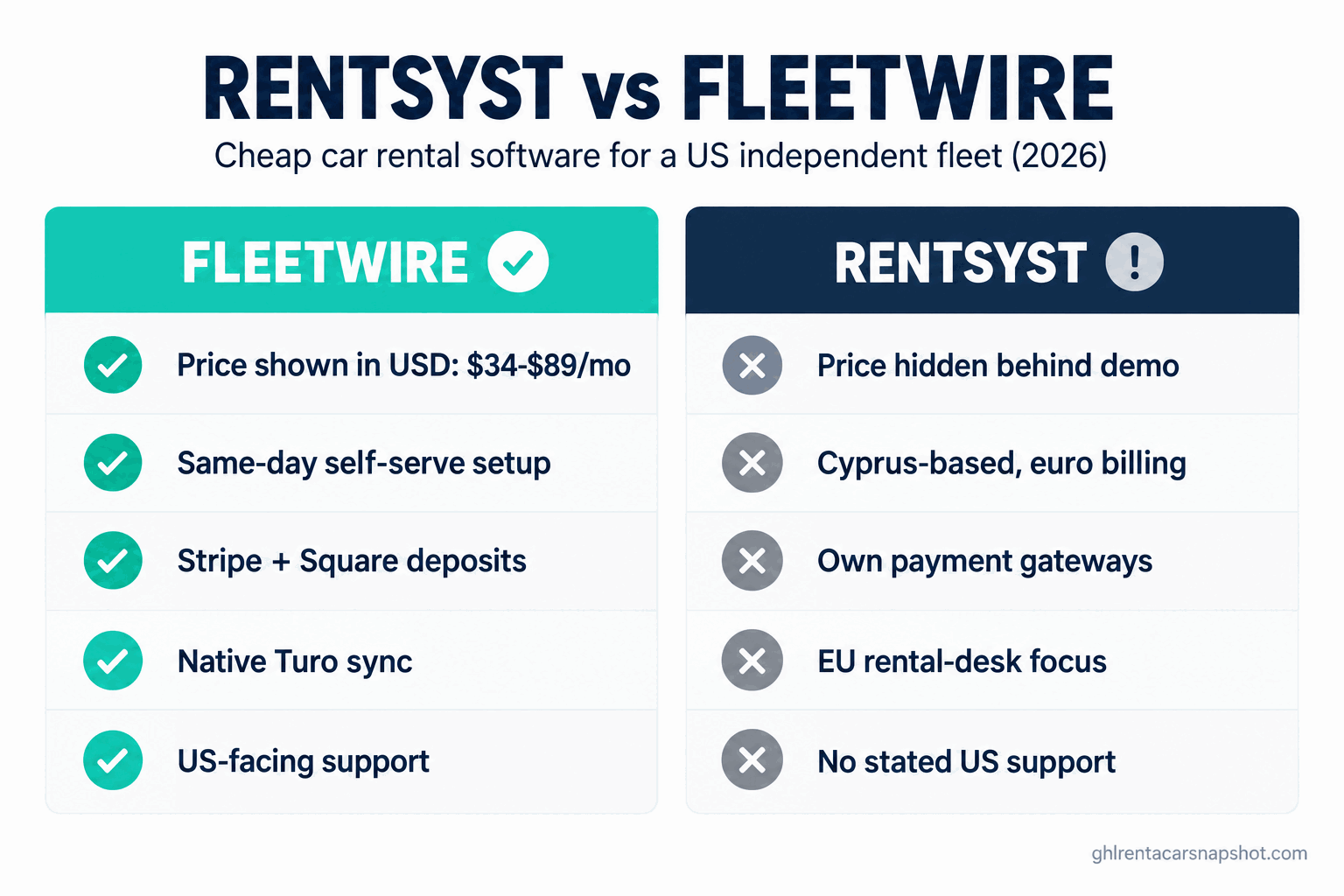
Key Takeaways
- Fleetwire publishes dollar prices; RentSyst makes you book a demo. Fleetwire lists $34/mo up to 5 vehicles, $89/mo up to 15, and $279/mo up to 150 (Fleetwire). RentSyst shows no price on its own site; third-party listings cite a ~€55/mo entry plan for up to 15 vehicles (Capterra).
- RentSyst is a European vendor. Its site lists a Cyprus address and a Cyprus phone number, prices in euros, and never mentions US support or dollars (RentSyst).
- Both make you responsible for texting law. A2P 10DLC and Florida’s FTSA apply no matter which platform sends the message.
- Your biggest cost is usually commission, not software. On Turo, 2026 plans keep 10% to 30% of every booking (Turo), which dwarfs any subscription here.
Table of contents
- The 60-second answer
- What the wrong cheap tool costs you
- How RentSyst and Fleetwire really differ
- The 8 things that decide it under $100 a month
- Steal these renter messages
- Same question, three fleet sizes
- The texting rules that bite either way
- Objections, answered
- FAQ
The 60-second answer
If you want a price before a sales call, same-day setup, Stripe deposits, and native Turo sync, Fleetwire is the right cheap buy. You sign up, import your cars, and take reservations that afternoon, on published bands of $34/mo up to 5 cars and $89/mo up to 15 (Fleetwire), with no setup fee.
RentSyst can work if you are fine booking a demo and you operate in Europe or bill in euros. But as a US independent you are buying from a Cyprus company, in a currency that is not yours, at a price you cannot see until you are on a call. The rest of this post tells you which operator you are, because the demo call will not.
What the wrong cheap tool costs you
Cheap software does not announce its weaknesses. It leaks money for a season, then you rip it out and migrate during your busiest month. No real pre-authorization hold means you eat the first scratched bumper; no clean Turo sync means a double-booked car on a holiday weekend; a vendor eight time zones away means a Friday-night payment failure waits until Monday. None of that shows up in the price comparison.
And there is a cost that swamps both tools. If you still hand Turo a slice of every rental, you pay far more than any tool here charges. Turo’s 2026 plans pay hosts 70%, 80%, or 90% of trip price by protection level, so Turo keeps 10% to 30% (Turo host share), across a platform that reported roughly 175,000 active hosts and 350,000 active vehicles in its mid-2023 filing (SEC EDGAR, 2023 S-1/A). On a car grossing $2,000 a month, a 20% cut is $400 gone every month, which makes the $55-versus-$89 question a detail. We ran the full comparison in Turo vs. your own booking system.
The surcharges you must collect dwarf the software too, and they differ by state. Florida charges renters $2 per day on most short-term rentals, plus $1 per day on peer-to-peer car-sharing (Fla. Stat. 212.0606). Colorado adds a $3 per day congestion impact fee the Tenth Circuit upheld 2-1 in July 2026 (Auto Rental News). Your software has to put those line items on the agreement correctly in dollars, another reason a US-built tool has an edge.
How RentSyst and Fleetwire really differ
Strip away the feature lists and these two have different personalities, and passports.
Fleetwire is the self-serve US tool for the operator who graduated from spreadsheets and Turo. It publishes its price in dollars, gives a 14-day free trial with no card, runs on Stripe or Square, and leans into car-sharing: ID verification, e-signed agreements, automated messaging, and calendar sync. One person can set it up in an afternoon.
RentSyst is the feature-dense European platform that wants a conversation first. Its homepage shows a demo button and no prices (RentSyst), lists a Cyprus address and a +357 phone number, and mentions no US support, dollars, or North American operations. The only numbers that exist come from third-party listing sites, in euros, and they disagree.
Here is the published price picture, as far as each vendor lets you see it.
Monthly price by tier, US dollars, 2026. Fleetwire figures are published; the RentSyst entry figure is a third-party listing converted from euros, not confirmed on RentSyst’s own site. Sources: Fleetwire, Capterra.
The 8 things that decide it under $100 a month
1. Can you even see the price?
Fleetwire shows three bands on one page: $34/mo up to 5 vehicles, $89/mo up to 15, $279/mo up to 150 (Fleetwire). RentSyst shows nothing on its own site. Third-party aggregators list a Beginner plan around €55/mo for up to 15 vehicles (Capterra), while one review site lists $1.99 per car instead. When a vendor’s own numbers are a mystery and the third-party numbers disagree, that is a signal.
Where it breaks: you discover the real price only after handing a sales rep your fleet size and email, and a price you negotiate for can go up at renewal. For how opaque pricing works across this category, see our 2026 car rental software pricing teardown.
2. Currency and the hidden FX tax
This is specific to buying a European tool as a US shop. RentSyst prices in euros. Your bank adds a foreign-transaction fee, usually 1% to 3%, and the euro-to-dollar rate drifts, so a €55 subscription is a different dollar amount every month, while your renters, surcharges, and Stripe payouts are all in dollars.
Where it breaks: your bookkeeping. Reconciling a floating foreign subscription against dollar revenue quietly makes the “cheaper” euro plan cost more than its sticker.
3. Setup and migration off your spreadsheet
Fleetwire is same-day: import cars, set rates, connect Stripe, take bookings without talking to anyone. RentSyst routes you through a demo and onboarding first, starting with a sales call rather than a signup.
Where it breaks: the migration itself. Nobody imports existing reservations and card-on-file holds cleanly the first time. Whichever you pick, run the old and new systems in parallel for two weeks and reconcile daily, so a booking in one does not become a double-booking in the other. We wrote that playbook in stop double-booking across Turo and your website.
4. Booking engine and Turo sync
Both give you an online booking page and a fleet calendar. Fleetwire’s edge is native sync with Turo and the car-sharing platforms, which matters if you are a power host building direct bookings without going dark on the marketplace. RentSyst’s booking widget aims more at European rental desks than at Turo hosts.
Where it breaks: a sync gap. If your direct site, Turo, and the front desk are not reading the same availability in real time, you rent the same car twice on a holiday weekend, so test the sync with a live booking first.
5. Payments, deposits, and card-on-file holds
This is where a cheap tool earns its keep or costs you a fender. You need a real pre-authorization hold on the card before the keys leave, not a vague promise to charge later. Fleetwire runs on Stripe and Square, so you get auth-and-capture holds directly, in dollars, with a processor you already understand. Confirm RentSyst’s payment gateways support US card holds the way you need before you commit.
Where it breaks: auth holds expire. A Stripe pre-authorization typically falls off after about a week, so a two-week rental needs a fresh hold or a different deposit mechanism, or you are exposed exactly when damage risk is highest. We broke down the mechanics in how to automate security deposit holds.
6. US support, time zone, and who picks up on Friday night
Fleetwire is a US-facing product with email support on every plan and phone support on the top tier. RentSyst’s published contact is a Cyprus phone number and an email, with no stated US hours (RentSyst). Cyprus is seven hours ahead of Eastern, so your Friday-evening rush, the busiest window in this business, lands in their night.
Where it breaks: a payment or sync failure during a weekend pickup. If the vendor’s support is asleep when your lot is slammed, you improvise with a frustrated customer at the counter.
7. Reporting and fleet utilization
Past 15 or 20 cars you cannot eyeball utilization. You need a report that shows which vehicles are earning and which are parked. Both report the basics; RentSyst leans heavier on fleet and telematics data, with GPS as a paid add-on, while Fleetwire stays lighter.
Where it breaks: you track revenue but not utilization, so a car that rents often at a bad rate looks like a winner. If your tool will not show it cleanly, calculate it with our fleet utilization-rate guide.
8. Contracts and getting your data out
Fleetwire is month-to-month and self-serve, so leaving is easy. RentSyst’s terms come out of a sales process, so read them for contract length and export rights first.
Where it breaks: the data-export question you never ask until you leave. Before you commit to either, confirm in writing that you can export customers, reservations, and vehicle history. A tool you cannot leave, run by a company you cannot reach, is one that can raise its price.
Steal these renter messages
The messaging feature is only as good as the words you put in it, and most operators leave it on the generic default. Here are texts a small fleet should run on either tool, each ending with an opt-out because A2P 10DLC and the TCPA expect it.
That block is the part both tools leave blank. The software sends it; you write it. See the five-star review pipeline for the full flow.
RentSyst vs Fleetwire for a US independent
| Plan | Fleetwire recommended | RentSyst |
|---|---|---|
| Price | $34-$89/mo (USD, published) | ~€55/mo entry (3rd-party, EUR) |
| Feature 1 | Prices on the site, in dollars | No price on its own site |
| Feature 2 | Same-day self-serve, 14-day trial | Cyprus-based, euro billing |
| Feature 3 | Native Turo / car-sharing sync | Demo-and-onboarding first |
| Feature 4 | Stripe + Square deposits | GPS / telematics add-ons |
| Feature 5 | US-facing support | No stated US support hours |
| Feature 6 | Month-to-month, easy exit | Contract terms via sales |
| Best cheap pick for US operators | Capable, but EU-centric |
A word on a third name you will see: Navotar. It has folded into RENTALL, its own pricing is not published, and RENTALL is demo-gated from around $120/mo on third-party listings. If transparent pricing matters to you, Navotar is a step in the wrong direction. We covered the replacements in Navotar alternatives for US independents.
Same question, three fleet sizes
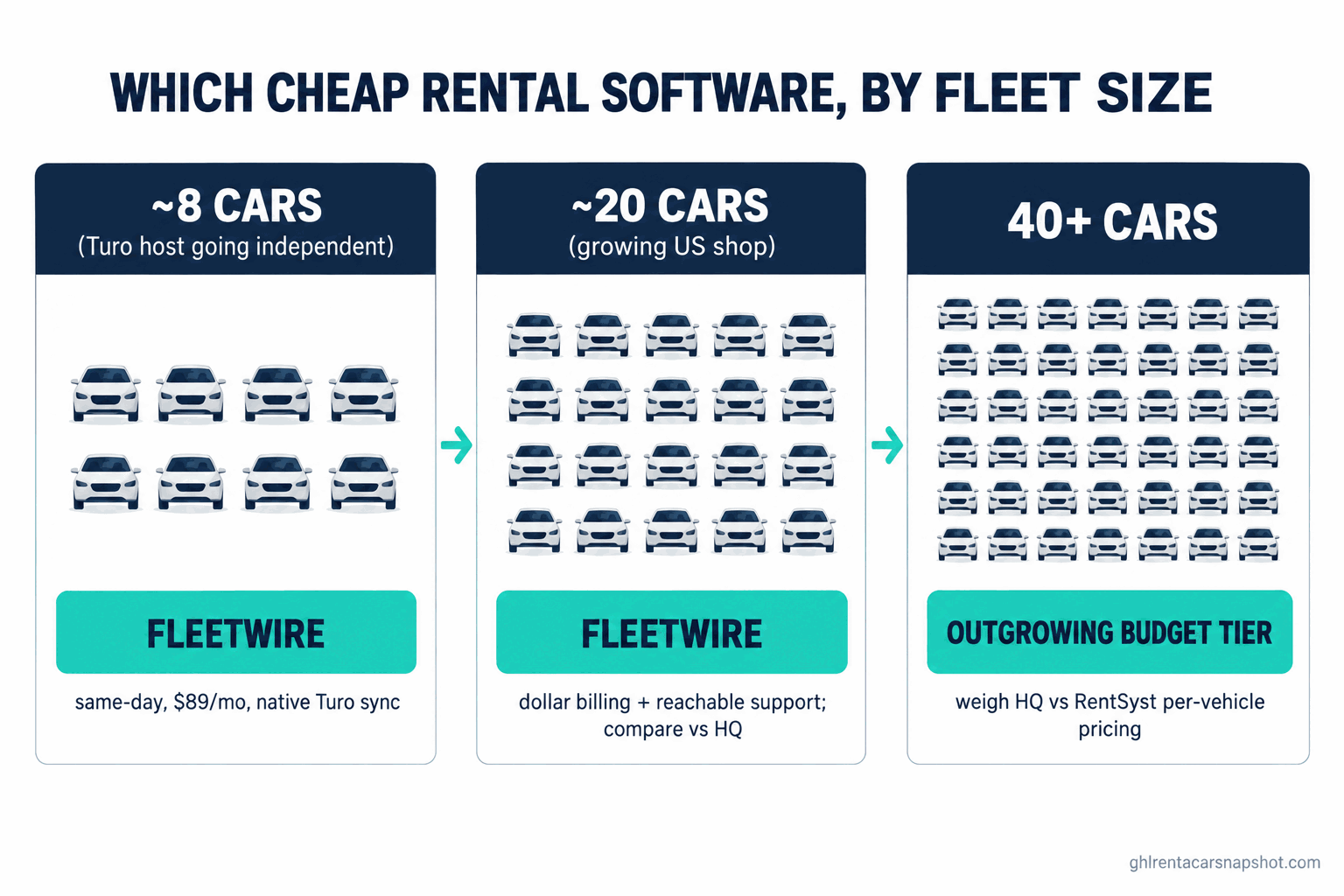
The right answer shifts with fleet size and where you operate.
Turo host going independent, about 8 cars. Fleetwire, clearly. You sit near its $89 up-to-15 band, you need speed and low cost, and native Turo sync keeps marketplace bookings flowing while you build a direct-booking habit. A euro-priced, demo-gated European tool is the wrong friction for a one-person shop that wants to be live this weekend.
Growing US shop, about 20 cars. Still Fleetwire for most operators, plus dollar billing and reachable support. RentSyst only makes sense here if you operate in Europe. At this size the cleaner contest is Fleetwire against HQ Rental Software, which we settled in Fleetwire vs. HQ Rental Software for a 20-car fleet.
40-plus cars. You are outgrowing the budget tier either way. Here you weigh a heavier platform like HQ against RentSyst’s per-vehicle tiers, and reporting matters more than saving $30 a month.
What stays constant across all three: the rental platform runs the booking and deposit, but none runs your lead follow-up, abandoned-reservation recovery, or review pipeline.
The texting rules that bite either way
Both platforms send texts. Neither keeps you legal. That is your job, and it bites hardest in Florida, a top rental market with real teeth in its law.
First, A2P 10DLC. To send business texts in the US you register your brand and campaign through the carriers. New campaign registrations submitted after June 30, 2026 must include a publicly accessible PrivacyPolicyUrl and a TermsAndConditionsUrl, or they are rejected at review (Twilio). No real privacy and terms pages yet? Fix that before you register.
Second, Florida’s FTSA. The Florida Telephone Solicitation Act is a mini-TCPA with a private right of action, so a renter and the lawyer who finds them can sue over improper marketing texts and recover the greater of $500 per violation or actual damages. The 2023 amendment narrowed it toward the federal autodialer standard (Goodwin Law), but the private right of action is still live. Rent in Florida, get clear express written consent before any marketing text.
The practical line: transactional texts (booking and return reminders) are lower risk because the renter handed you their number to do business; marketing texts (promos, win-backs) need real consent. We go deeper in texting rental reminders without a TCPA or 10DLC disaster.
Objections, answered
“RentSyst looks cheaper at €55. Why not just take the cheapest?” Because the sticker is not the bill. Add your bank’s foreign-transaction fee, the floating euro rate, and support seven time zones away, and the gap to Fleetwire’s $89 narrows fast. RentSyst is not a scam, it is a real product with real customers, mostly outside the US. The problem is fit, not quality; if you operate in Europe the calculus flips.
“I already pay for one of these. Should I switch to save money?” Probably not for the monthly difference alone. Switching costs a migration, retraining, and the risk of a double-booking during the overlap. Switch if the tool is genuinely wrong for how you operate, not to save $30.
“Can’t I just keep using Turo and skip all this?” You can, and you will keep paying Turo 10% to 30% of every booking to do it (Turo host share). A rental platform plus a direct-booking site is how you stop renting your own customers back from a marketplace, a question worth far more than the $55-versus-$89 one.
Frequently asked questions
Is RentSyst or Fleetwire better for a US independent car rental business?
For most US operators, Fleetwire. It publishes dollar prices, sets up same-day, runs on Stripe, and syncs with Turo. RentSyst is a capable European platform, but it is Cyprus-based, prices in euros, hides its pricing behind a demo, and does not advertise US support, which adds friction for a US shop.
How much does Fleetwire cost?
Fleetwire publishes tiered pricing in US dollars: about $34/mo for up to 5 vehicles, $89/mo for up to 15, and $279/mo for up to 150, with a 14-day free trial and no setup fee. You pay standard Stripe or Square processing (about 2.9%) on top.
How much does RentSyst cost?
RentSyst does not show pricing on its own website. Third-party listings cite an entry plan around €55/mo for up to 15 vehicles, then per-vehicle tiers above that, but the figures vary and are in euros. Confirm the real number and currency on a demo first.
Where is RentSyst based?
RentSyst's website lists a Cyprus address and a +357 Cyprus phone number, and prices in euros. It does not state US support hours, so for a US operator it means a vendor seven time zones ahead and a subscription that floats against the dollar.
Does either platform keep me TCPA and A2P 10DLC compliant?
No. Both send texts, but registration and consent are your responsibility. From June 30, 2026, new A2P 10DLC campaigns must list a privacy policy URL and a terms URL. In Florida, the FTSA adds a private right of action, so get express written consent before marketing texts.
What is the cheapest reliable car rental software for a small US fleet?
For a self-serve, dollar-priced, same-day option under $100/mo, Fleetwire's $89 up-to-15 plan is the strongest cheap pick. The bigger savings usually come from cutting Turo's 10% to 30% commission with a direct-booking site, not from shaving $30 off a subscription.