
You signed up for Fleetwire on a Sunday, imported your fourteen cars, and felt like a real rental company for a week. Then a guy who DM’d you on Instagram three days ago finally booked, with a different shop, because nobody texted him back. Your software did its job. It held the calendar and took the deposit. It just never told you a lead was going cold.
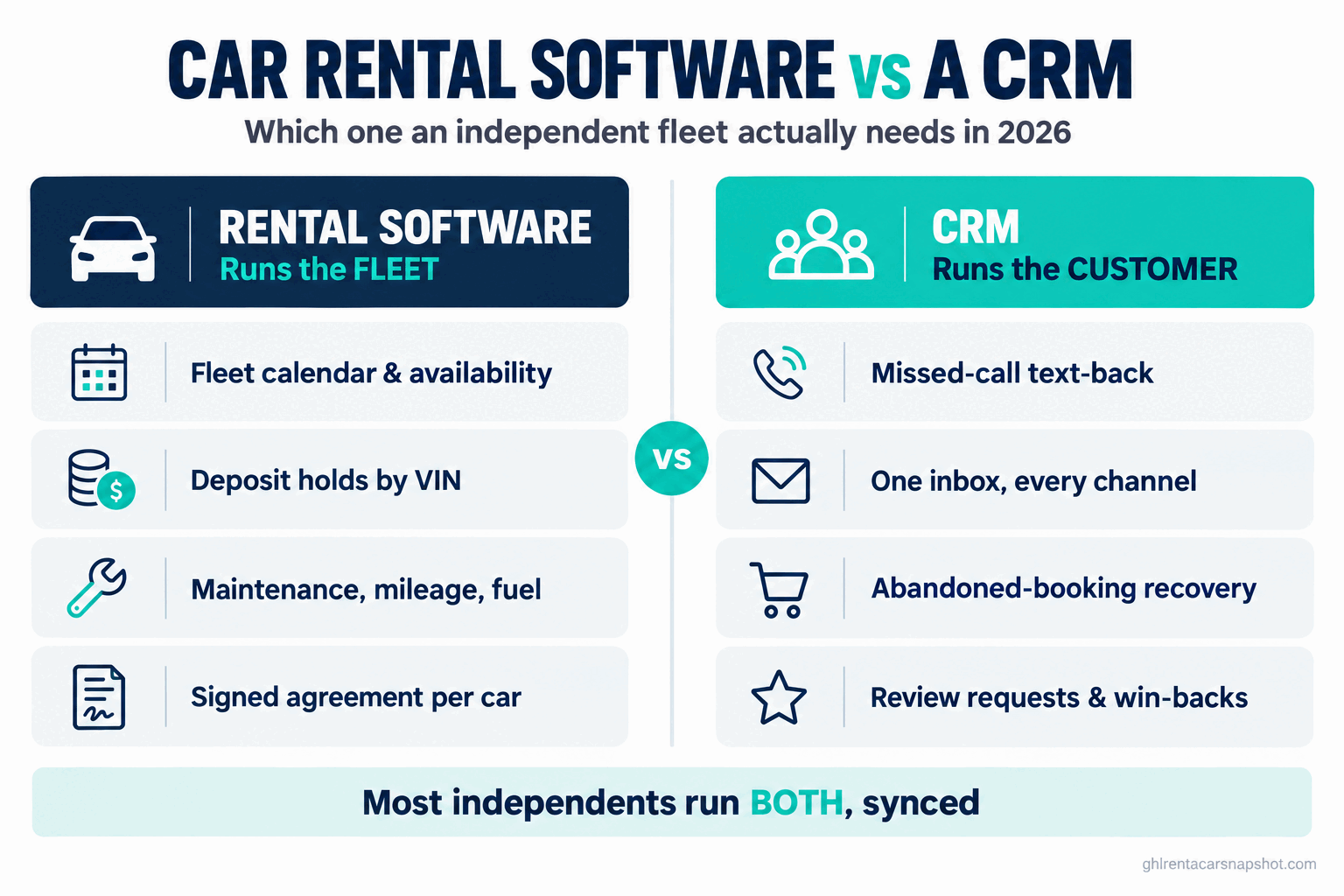
That is the gap nobody warns you about. Dedicated car rental software runs the fleet. A CRM runs the customer. Two categories, two jobs, and most operators buy one, assume it covers the other, and quietly leak bookings for a year.
Here is the short version. If your problem is “my calendar is a mess and I eat damage I cannot prove,” you need rental software like Fleetwire or HQ Rental Software. If your problem is “I keep losing leads and I never follow up,” you need a CRM. If you are honest, you have both, which is why the shops that grow run a lean rental tool for the fleet and a CRM for everything that touches a human.
Key Takeaways
- They solve different problems. Rental software manages vehicles (availability, rates, contracts, deposits, maintenance, damage). A CRM manages people (capturing the lead, answering fast, following up, winning the review).
- A booking tool does not chase a cold lead. Fleetwire and HQ hold the reservation once it exists. Neither texts back a missed call, recovers an abandoned checkout, or asks for the review.
- Price is not the deciding factor. Rental software and an all-in-one CRM both land in the $34 to $297/mo range. The real money is commission and missed leads, not the subscription.
- Both make the texting law your problem. A2P 10DLC and the Florida FTSA apply no matter which platform sends the message.
Table of contents
- The 60-second answer
- What the wrong category costs you
- Two tools, two jobs
- The 8 questions that decide which you buy first
- Steal these front-of-house messages
- Same decision, three fleet sizes
- The texting rules that apply either way
- Objections, answered
- FAQ
The 60-second answer
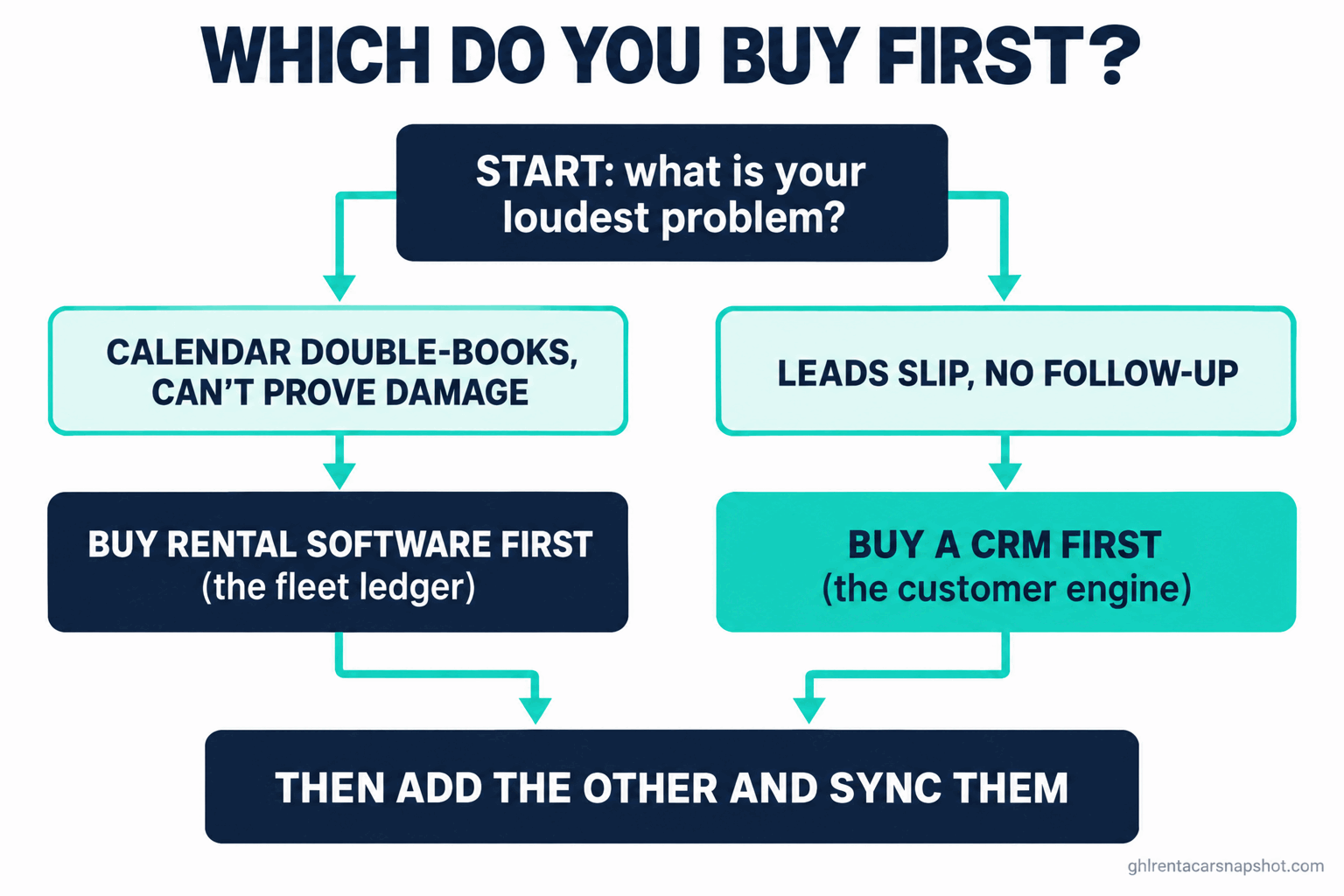
Buy the tool that fixes your loudest problem first, then add the other.
If your calendar double-books cars, you cannot prove damage at return, and your rates live in your head, start with dedicated rental software. That is the fleet ledger, and nothing else does odometer, fuel, maintenance, and damage lines as cleanly.
If your cars are mostly booked but leads are slipping (a missed call at 7pm, an Instagram DM that waits two days, a quote you forgot to chase), start with a CRM. That is the customer engine: speed-to-lead, follow-up, reviews, and repeat business. Most shops running 10 to 100 cars have both problems and end up running both tools, synced. The question is only which comes first.
What picking the wrong category costs you
Buying the wrong category feels like progress at first, but the leak shows up later, in two directions.
Buy rental software and skip the CRM, and your fleet is organized but your front desk is still a human racing a clock. The odds of qualifying a lead drop off a cliff after the first few minutes, most small operators answer in hours, and the booking tool is happy to hold a reservation that never gets made because nobody replied. Go the other way, skip the rental software, and you capture every lead but run the fleet out of a spreadsheet: you book a car that is in the shop, or hand back a deposit on a scratch you cannot document and lose the chargeback. The expensive version is buying one, forcing it to do the other job badly for a season, then ripping it out mid-season. You pay twice, so deciding the category up front is the cheapest thing you will do all year. If slow lead response is the symptom, see the one-inbox system that answers every lead in 60 seconds.
Rental software vs. CRM: two tools, two jobs
Strip away the marketing and the two categories barely overlap.
Dedicated rental software is a fleet operations system. It thinks in vehicles: the car, the class, the rate, the reservation, the agreement, the inspection. It is very good at what a fleet needs: live availability across classes, rate rules, mileage and fuel tracking, maintenance scheduling, deposit holds, and a signed contract tied to a VIN. Fleetwire and HQ Rental Software live here.
A CRM is a customer system. It thinks in people: the contact, the conversation, the pipeline stage, the automation. It is very good at catching a lead from any channel, texting back a missed call, keeping every message in one inbox, running follow-up, asking for reviews, and marketing to past renters. An all-in-one platform like GoHighLevel sits here and adds a booking calendar and website, which is where the line gets blurry.
The blur is the trap. An all-in-one CRM takes a booking, so people assume it replaces rental software; it does not replace the fleet ledger. Rental software sends a text, so people assume it replaces a CRM; it does not run speed-to-lead or follow-up. Each does the other’s job at a hobby level.
The 8 questions that decide which you buy first
Whichever column racks up more “that is my pain right now” wins.
1. Is your calendar accurate, or do you double-book?
Rental software’s job. A real fleet calendar with class-based availability stops you from renting a car that is already out or in for service. A CRM calendar books appointments, not vehicles, and does not know the car is in the shop. Run availability out of a spreadsheet and you will double-book on a holiday weekend. See how to stop double-booking across Turo, your site, and the front desk.
2. Can you take a deposit and a card-on-file hold?
Both, differently. Rental software ties a pre-authorization hold to a reservation and a VIN. A CRM takes the payment and stores the card, but does not track it against a vehicle’s return inspection. A “deposit” that is a plain charge, not a real pre-auth hold, means you refund manually and eat the scratched bumper. Get it right in how to automate security deposit holds.
3. Do you get a signed contract before the keys leave?
Rental software’s job, CRM-assisted. The rental tool generates the agreement tied to the car and the dates; a CRM sends the e-sign link and chases the signature with reminders. Together they get a signed contract before pickup instead of a clipboard at the counter. Paper and WhatsApp screenshots do not hold up in a dispute, so move to a real digital rental agreement and e-sign flow.
4. Do you track maintenance, mileage, fuel, and damage by car?
Rental software, no contest. This is the fleet ledger: odometer history, service intervals, fuel in and out, and timestamped damage lines on a VIN. No CRM does this. Without per-car maintenance holds you rent a car that is due for service and it fails mid-trip. If proving damage is your pain, rental software or a dedicated damage-photo system is the buy.
5. Do leads slip because nobody answers fast enough?
CRM, no contest. Missed-call text-back, a one inbox that pulls phone, website, Google, Instagram, Facebook, and Turo into one thread, and instant auto-replies. Rental software does not watch your Instagram DMs. If your cars are fine but your response time is not, this is the buy. See missed-call text-back for car rental.
6. Do you follow up, win reviews, and bring renters back?
CRM, no contest. Abandoned-booking recovery, no-show win-backs, review requests after a clean return, and campaigns to past renters. No rental software runs this, and it is where repeat revenue comes from. Skip it and every rental is a one-night stand. See the 5-star review pipeline and the repeat-renter loyalty flywheel.
7. Do your tools talk to your accountant and your other channels?
Both, check the specifics. Rental software usually exports to QuickBooks and imports from Turo. A CRM integrates with your website, calendar, and ad platforms. The question is whether a booking in one flows to the other without you retyping it. If the two do not sync, you are the integration, copying reservations by hand at 11pm.
8. What is the real total cost?
Neither subscription is the real cost. Fleetwire runs $34 to $279/mo (Fleetwire), HQ starts around $120/mo (SoftwareAdvice), and an all-in-one CRM is $97 to $297/mo plus usage (GoHighLevel). Those are close enough that price should not decide this. The cost that dwarfs them is commission. Here is a 20-car fleet grossing an illustrative $240,000 a year, platform cut against software cost.
Illustrative 20-car fleet grossing $240k/year. Turo’s cut runs 10% to 40% by plan; 30% shown. Software uses Fleetwire ≤150 ($89/mo) and GoHighLevel Unlimited ($297/mo). Sources: Turo, Fleetwire, GoHighLevel.
That is the argument for going independent. Turo hosts earned about $1.4 billion across 5.5 million US trips in 2025 (Turo), and the platform keeps 10% to 40% of every booking by plan (Turo). Saving $30 a month on software is a rounding error next to that. We run the math in Turo vs. your own booking system and the 2026 pricing teardown.
Rental software vs. CRM: who owns which job
| Plan | Dedicated rental software | All-in-one CRM recommended |
|---|---|---|
| Price | $34-$279/mo (Fleetwire) · $120+/mo (HQ) | $97-$297/mo (GoHighLevel) + usage |
| Feature 1 | Fleet calendar + class availability | Missed-call text-back, one inbox |
| Feature 2 | Maintenance, mileage, fuel by car | Speed-to-lead auto-replies |
| Feature 3 | Deposit holds tied to a VIN | Abandoned-booking recovery |
| Feature 4 | Signed agreement per vehicle | Review requests + win-backs |
| Feature 5 | QuickBooks + Turo import | Website, funnels, booking calendar |
| Feature 6 | No follow-up or review automation | No per-car maintenance or damage ledger |
| Best for fleet operations | Best for winning + keeping renters |
Steal these front-of-house messages
This is the part no rental software ships. Edit the brackets and load them into whatever tool sends your texts.
Notice what they have in common: they are about the person, not the vehicle. That is the tell. If a message catches, confirms, or keeps a human, it is a CRM job.
Same decision, three fleet sizes
The right answer changes with your size. Here is how the decision actually plays out.
Solo operator, 5 to 12 cars
You are the front desk, the detailer, and the accountant. Your biggest leak is not fleet chaos; it is that you cannot answer every inquiry while you are flat on a creeper under a car. Buy the CRM first. Missed-call text-back and a one inbox stop the bleeding on day one, and the built-in booking calendar is enough for a dozen cars. Add a cheap rental tool like Fleetwire’s $34 plan when the calendar gets scary. See running your rental on spreadsheets and WhatsApp.
Mid-size team, 20 to 40 cars
Now both problems are real. The calendar needs class-based availability, and slow follow-up is costing bookings. Buy both: rental software for the fleet, CRM for the front of house, synced. This is where running the two together pays for itself fastest.
Larger operation, 50 to 100 cars
The fleet ledger is non-negotiable, so you are likely on HQ Rental Software or something comparable with multi-location and QuickBooks support. The mistake here is assuming the heavier platform’s basic messaging covers marketing. It does not. The CRM is the growth lever: structured pipelines for corporate accounts, serious review volume, and win-backs to a past-renter list now worth real money. See winning and keeping corporate accounts.
The pattern: the CRM job never disappears, it changes shape. The fleet job shows up around 15 cars and gets heavier from there.
The texting rules that apply either way
Whichever category you buy, the second you send an automated text you are responsible for the law, not the vendor. Three things to get right in 2026:
A2P 10DLC registration. To send business texts to US numbers you register a brand and a campaign through your provider. Starting June 30, 2026, new A2P 10DLC campaign registrations must include a privacy policy URL and a terms-and-conditions URL (Twilio). If your website does not have both pages live, your campaign gets rejected and your texts do not send.
Consent and opt-out. Transactional texts (confirmations, pickup and return reminders) are lower risk because the renter handed you their number to do business. Marketing texts (promos, win-backs) need logged express written consent and a working STOP. We go deep in texting rental reminders without a TCPA or 10DLC disaster.
Florida, if you touch it. The FTSA carries a private right of action with statutory damages of $500 per violation, trebled to $1,500 for willful ones, and a text safe harbor that hinges on honoring STOP (Greenspoon Marder). For a Miami or Orlando operator, that is not theoretical.
Objections, answered
“Can’t my rental software just send the follow-ups?” It can send a message, the way a Swiss Army knife has scissors. Rental tools fire templated reminders tied to a reservation. They do not watch six inbound channels, text back a missed call in under a minute, run a multi-step abandoned-booking sequence, route a bad review away from Google, or market to last summer’s renters. Those are CRM jobs.
“I already pay for HQ. Why add a second tool?” Because HQ runs your cars well and barely touches your customers. A CRM does not replace HQ; it bolts on the part HQ was never built to do. The two sync: a booking in HQ becomes a contact in the CRM, and the CRM runs the follow-up HQ cannot. You keep the fleet ledger and stop leaking leads around it.
“Isn’t an all-in-one supposed to do everything?” An all-in-one CRM does lead-to-customer everything and takes bookings for a small fleet. It does not do fleet operations: no per-car maintenance, no odometer history, no damage lines on a VIN. For 10 cars you can stretch it. For 40, you want the real fleet tool underneath.
“Do I need to be technical to run a CRM?” No, but the setup is real work: wiring the channels, writing the sequences, registering 10DLC, building the review flow. That is the part operators underestimate, and the reason a pre-built system exists.
Finish the thought
Back to the lead who booked with the other shop. Your Fleetwire calendar never did anything wrong. The car was available, the price was right, the contract was ready. The booking died in the twenty seconds it took a human to not reply, and no fleet tool watches for that. That is the whole case for a CRM next to your rental software: one runs the cars, the other makes sure a ready car turns into a booked one.
So pick the tool that fixes your loudest problem first, then add the other. At 10 to 100 cars you need both, and the operators who grow stopped pretending one tool could do it all.
What is the difference between car rental software and a CRM?
Car rental software manages the fleet: availability by class, rates, reservations, agreements, deposit holds, maintenance, and damage tracked by vehicle. A CRM manages the customer: capturing leads, texting back fast, following up, running reviews and win-backs. One runs the cars, the other runs the people, and they overlap only at the booking.
Do I need both for a small car rental business?
For 5 to 12 cars you can often start with just an all-in-one CRM, which takes bookings and runs your follow-up, while you keep the fleet in a spreadsheet. Once double-booking becomes a risk, around 15 cars, add dedicated rental software and sync the two. Most operators running 20 or more cars run both.
Can GoHighLevel replace dedicated car rental software?
For a small fleet it handles the booking, website, and all customer-facing work. It does not replace the fleet ledger: no per-car maintenance, odometer history, or damage lines tied to a VIN. Larger operators run it for the customer engine alongside a rental platform like Fleetwire or HQ for the vehicles.
Which should I buy first?
Buy the one that fixes your loudest problem. If leads slip because nobody answers fast enough, buy the CRM first. If your calendar double-books and you cannot prove damage at return, buy the rental software first. Then add the other, because at 10 to 100 cars both problems show up.
Does rental software or a CRM keep me TCPA and A2P 10DLC compliant?
Neither. Both send texts, but registration and consent are your responsibility. From June 30, 2026, new A2P 10DLC campaigns must list a privacy policy URL and a terms URL. Florida's FTSA adds a private right of action, so get logged express written consent before marketing texts and honor STOP. The one-to-one consent rule was vacated in January 2025, so do not build around it.