
It is a Tuesday in February and you just pulled your six cars off Turo to run them under your own name. You call a commercial broker for a quote, rattle off the vehicles, and the line goes quiet. Then he says the number, and it is four times what you budgeted. You hang up wondering if going independent was a mistake.
Here is the short version so you can plan with real numbers. The protection you had on Turo was never your insurance. It belonged to Turo, bundled into the cut they took from every trip. The day you go independent that coverage vanishes, and your personal auto policy will not fill the gap, because it excludes renting your car to the public. You now need a commercial stack built for a for-hire fleet, and yes, it costs more than you are used to. This guide breaks down every coverage you need, what each one runs in 2026, and three cost scenarios for a solo lot, a mid-size fleet, and an exotic operation.
Key Takeaways
- Your Turo protection was rented, not owned. It came out of Turo’s commission, so it leaves with Turo. A personal auto policy will not cover a car you rent to the public because of the public-or-livery exclusion.
- For-hire use is the cost driver. A minimum commercial auto policy averages about $163 a month, but the same insurer that quotes a sedan at $110 quotes a taxi at $791, because many different drivers means more claims. A rental fleet sits closer to the taxi end.
- The Graves Amendment is a free shield. This 2005 federal law blocks most vicarious-liability claims against rental companies, so a renter’s crash is usually not automatically your lawsuit. It does not cover your own negligence.
- Treat every number here as a planning range. Insurance pricing turns on your state, your loss history, your vehicle values, and your limits. Get a real quote from a rental-specialty broker before you commit.
Table of contents
- Why your Turo coverage disappears the day you go independent
- The coverage stack a for-hire rental fleet actually needs
- What does car rental insurance cost per vehicle in 2026?
- The Graves Amendment: the federal shield most operators never heard of
- Three fleet scenarios: what a solo, mid-size, and exotic operation pays
- The compliance piece you cannot skip once you text renters
- Common objections, answered
- Frequently asked questions
Why your Turo coverage disappears the day you go independent
Most independent operators came off a platform. Turo closed 2024 with about 140,000 active hosts and 340,000 active vehicles, by the company’s own count (Turo, 2025). Many of those hosts are building a direct-booking brand on the side, and almost none understand what happens to their insurance when they leave.
On Turo you pick an earnings plan: you keep 70, 80, or 90 percent of the trip price and Turo keeps the rest, with your damage responsibility rising as your share goes up (Fleetwire, 2026). That 10 to 30 percent cut is not just a booking fee. It pays for the protection plan over every trip. The coverage was real, but it was Turo’s policy, priced into the commission. You were renting protection by the trip.
Go independent and that ends, and your personal auto policy will not take over. The standard personal auto policy excludes a vehicle used as a “public or livery conveyance,” a car you make available to the general public for hire (IRMI). Most personal policies also exclude business use outright, and a car rented to a stranger is about as business as it gets. Utah’s insurance department puts it plainly: an un-endorsed personal auto policy does not cover vehicles transported for hire (Utah Insurance Department).
The coverage stack a for-hire rental fleet actually needs
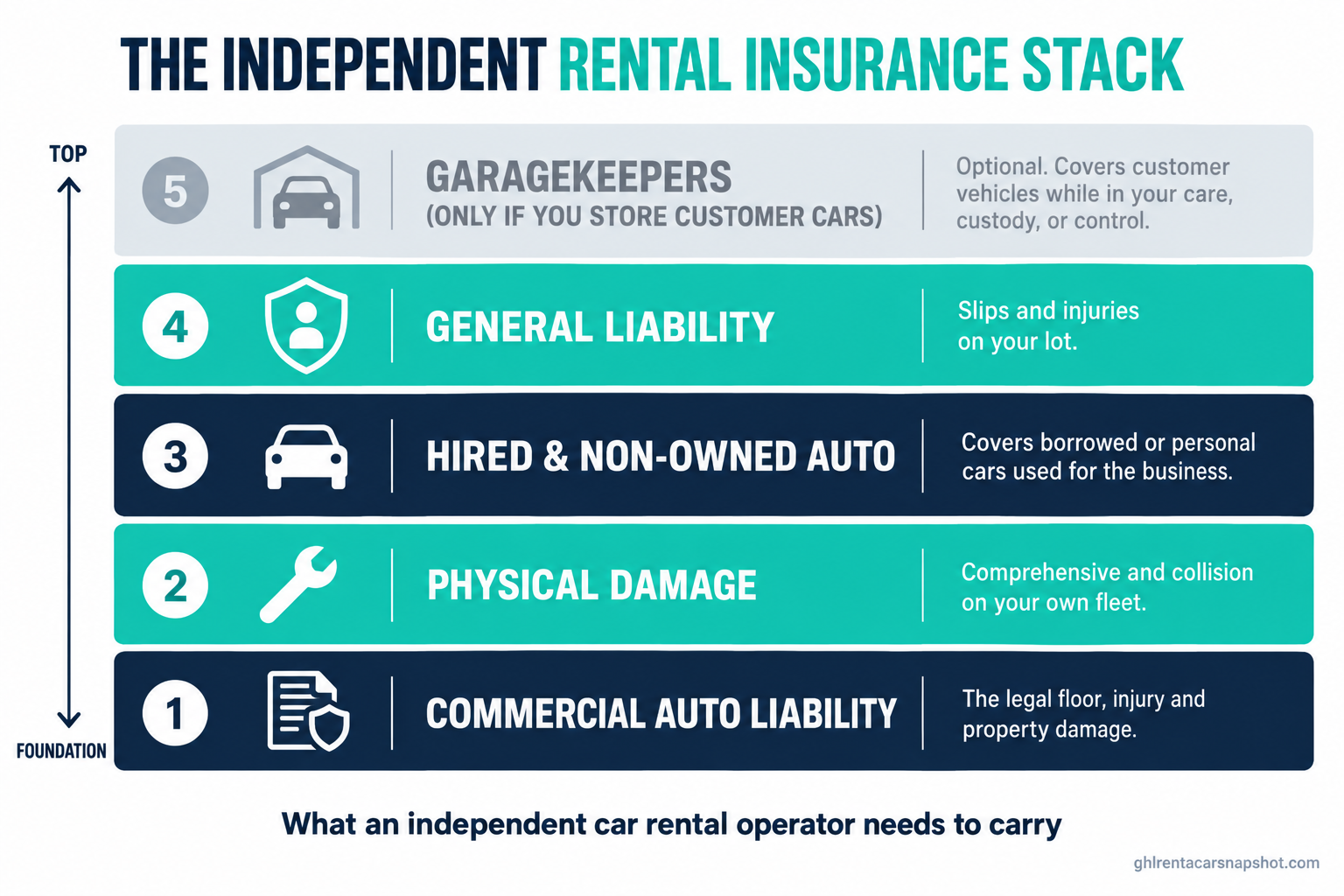
Independent rental insurance is not one policy. It is a stack, and skipping a layer is how one bad rental turns into a business-ending bill. Here is what each layer does and where it fails.
Commercial auto liability. The floor. It pays for injury and property damage you are legally responsible for when one of your vehicles is in an accident. Every state sets a minimum financial-responsibility limit, and rental companies often face their own rules on top of it. Florida, a top rental market, writes specific requirements for rental companies into Chapter 324 (Fla. Stat. ch. 324). The state floor keeps you legal, but a serious injury blows past a low limit fast, which is why most operators carry more.
Physical damage: comprehensive and collision. This covers your own cars. Comprehensive handles theft, vandalism, hail, and fire; collision handles crashes. A financed or leased vehicle will require it. On an owned car it is your call, but a totaled car with no physical-damage coverage is a direct hit to the asset that earns your money.
Hired and non-owned auto. The quiet one. If you or an employee ever drives a personal or borrowed car for the business, this fills a gap your commercial auto policy leaves open (Utah Insurance Department). Cheap to add, expensive to be without.
General liability. The non-driving accidents. A customer slips on your lot or gets hurt in your office. Commercial auto does not touch that. General liability does.
Garagekeepers, only if you actually keep cars. Here operators get oversold. Garagekeepers pays for damage to a customer’s vehicle left in your care, custody, and control (biBERK). It is built for repair shops and valet operations. A pure rental business rents its own cars, so your fleet is covered by physical damage, not garagekeepers. You only need it if you also store or service vehicles that belong to other people. Ask your broker which bucket you fall in before paying for a line you do not use.
What does car rental insurance cost per vehicle in 2026?
Here is the part everyone wants, and the honest answer is “it depends.” Rental pricing is not published the way a software fee is, so anchor on what is public for commercial auto, then adjust up for for-hire use.
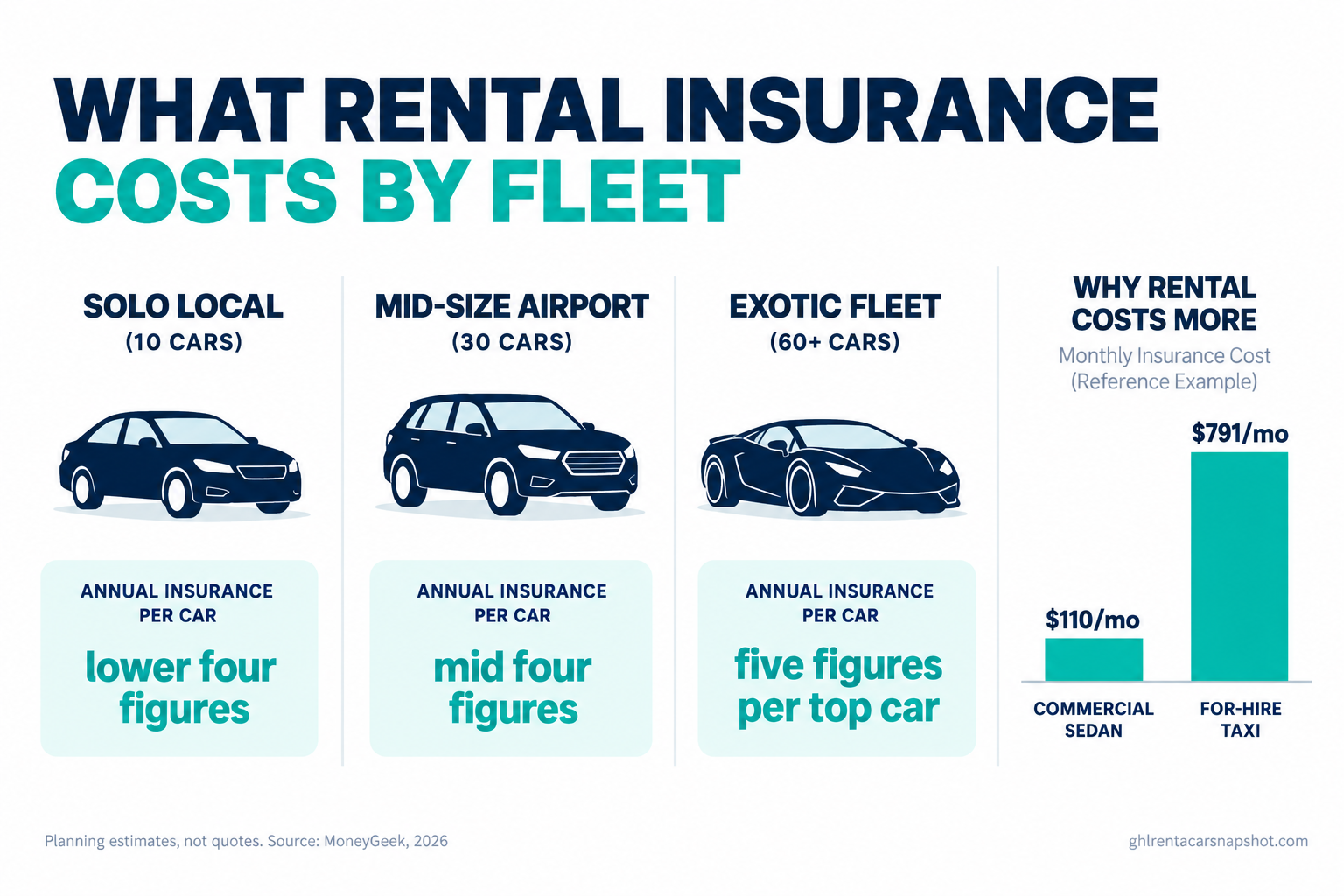
A 2026 national benchmark puts a minimum-coverage commercial auto policy at about $163 a month, or $1,959 a year, as a modeled starting point, not a quote (MoneyGeek, 2026). But the per-vehicle number swings hard on how the car is used. The same report prices a sedan at about $110 a month and a taxi at $791. That gap is the whole lesson. A taxi costs seven times a sedan not because the car is different but because many different drivers means more claims, and a rental fleet is rated on the same logic.
Average commercial auto insurance by vehicle type, dollars per vehicle per month, 2026 modeled benchmarks. For-hire use (the taxi line) is the closest public proxy for a rental fleet’s risk profile. Source: MoneyGeek, 2026.
Industry matters too. The same benchmark runs from about $89 a month in low-risk fields to $349 in transportation and logistics (MoneyGeek, 2026), and rental sits on the higher side. So a broker quoting a few hundred dollars per car per month is not gouging you. He is pricing the fact that a stranger drives your asset for a weekend and hands it back.
The Graves Amendment: the federal shield most operators never heard of
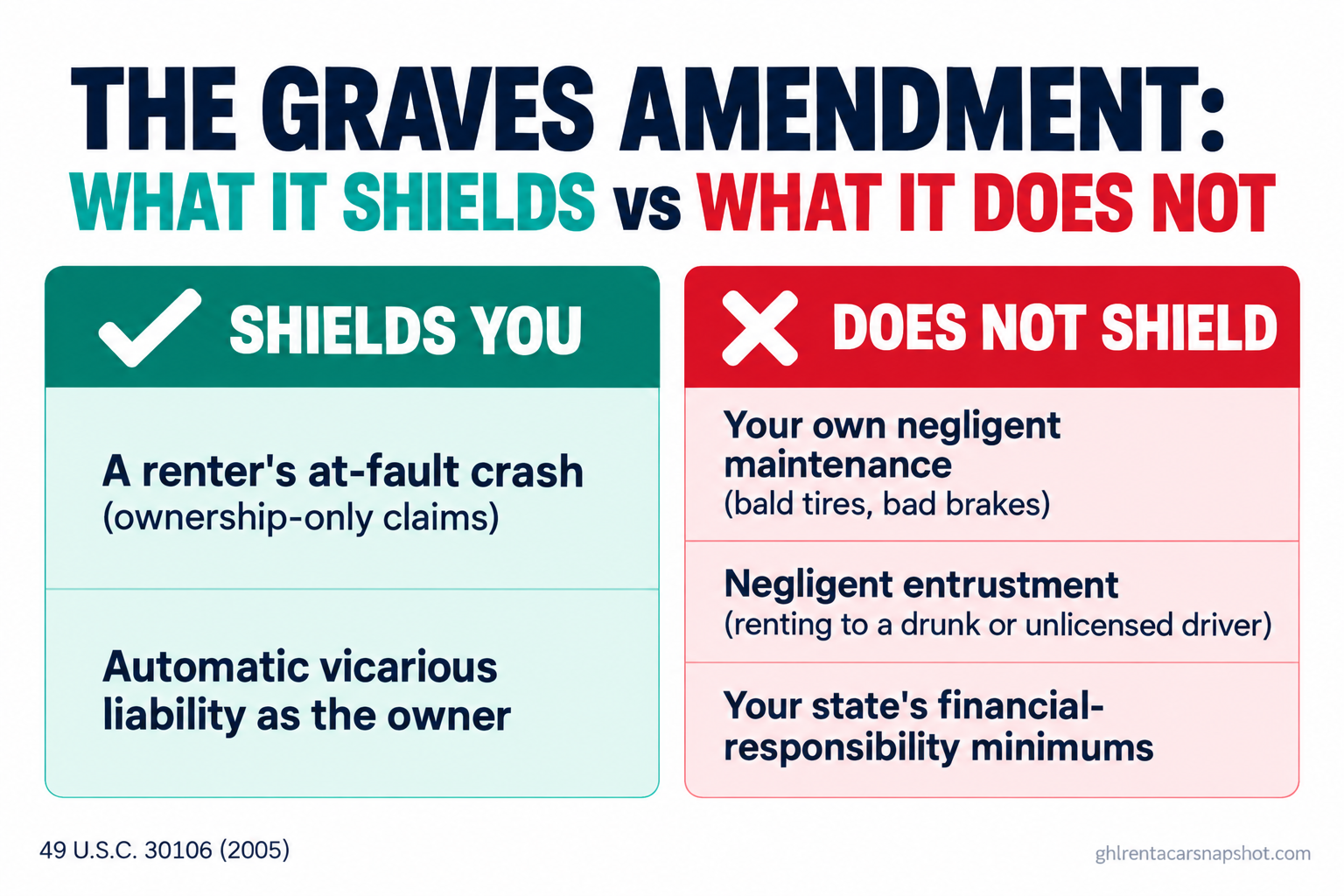
Here is good news almost no new operator knows about. In 2005, Congress passed what the trade calls the Graves Amendment, codified at 49 U.S.C. 30106. In plain English, it blocks states from holding a rental company automatically liable for a renter’s crash just because it owned the car, as long as you are in the trade and were not negligent yourself (Lewis Brisbois). Before Graves, in states like Florida and New York, a renter who crashed could drag the owner, meaning you, into the lawsuit on ownership alone.
The protection has edges. Graves does not shield your own negligence. A car rented out with bald tires or bad brakes is negligent maintenance, and it is on you. It does not shield negligent entrustment, like handing keys to someone you knew was drunk or unlicensed. And a savings clause lets states still require you to meet their financial-responsibility minimums (Lewis Brisbois).
Three fleet scenarios: what a solo, mid-size, and exotic operation pays
The same coverage stack costs very different amounts depending on your fleet. These are planning ranges built from the per-vehicle benchmarks above and the reality that for-hire rental runs toward the top of them. Your real quote will differ. Use them to sanity-check a broker, not as a promise.
| Operation | Fleet | Likely annual insurance range | What drives it |
|---|---|---|---|
| Solo operator, local | 10 economy and midsize cars | lower-to-mid four figures per car | Low vehicle values, local miles, one careful owner-driver. Carry state limits plus a cushion. |
| Mid-size, airport-adjacent | 30 mixed SUVs and sedans | mid four figures per car | More drivers, out-of-town renters, higher limits for airport liability exposure. |
| Exotic or luxury | 60-plus high-value cars | five figures per car on the top vehicles | Agreed-value physical damage on cars worth six figures, theft exposure, high liability limits. |
Solo operator, 10 cars, local. Keep it lean and legal. Commercial auto at your state’s rental-company limit with a cushion, physical damage on anything financed, general liability for the lot, and hired-and-non-owned for your errands. Your edge is low vehicle values and a clean loss history, so protect the history. One at-fault claim in year one reprices everything.
Mid-size lot, 30 cars, airport-adjacent. Now you carry higher liability limits, because an airport renter who crashes on the interstate is a bigger exposure than a local weekend rental. You are renting to more drivers you have never met, so underwriting gets stricter and your verification process starts to matter to your premium.
Exotic or luxury fleet, 60-plus cars. A different universe. Physical damage on a car worth six figures has to be written on an agreed-value basis, or a total loss pays you the depressed cash value and you eat the rest. Liability limits run high because one crash in a high-horsepower car is a catastrophic claim. Here insurance is one of your largest costs, and the damage-photo documentation that keeps a claim from being denied is not optional.
Monthly commercial auto insurance by industry risk, dollars per month, 2026 modeled benchmarks. Rental and for-hire operations sit on the high side of this spread. Source: MoneyGeek, 2026.
If these numbers make the independent model look shaky, run the other side of the ledger. On Turo you were already paying for protection through that 10 to 30 percent commission (Fleetwire, 2026). On a car doing $2,000 a month in bookings, the 20 percent plan hands Turo $400 a month, part of which was your insurance all along. Your own commercial policy, on direct bookings with no platform cut, often pencils out better once you are past a handful of cars. That math is the real reason hosts go independent, and it is covered in running your own booking system versus Turo and the go-independent playbook.
The compliance piece you cannot skip once you text renters
Insurance protects you from the crash. Compliance protects you from the regulator, and the moment you start texting renters a booking confirmation or a return reminder, you are inside a different set of rules that carry their own penalties.
If you send marketing or reminder texts in the United States, you register your brand and campaign under A2P 10DLC. As of June 30, 2026, campaign registration requires a published privacy policy URL and a terms-and-conditions URL, so both need to be live on your site before you register. On top of the federal TCPA, state mini-TCPA laws apply, and Florida’s FTSA matters most here because Florida is a top rental market and the FTSA carries a private right of action, meaning a renter can sue you directly. One clarification that trips people up: if anyone tells you a “one-to-one consent” rule applies to your lead forms, it does not. The FCC rule that would have required it was vacated in January 2025 and never took effect. The full ruleset, consent language, and the texts that stay inside it are in the TCPA and 10DLC compliance guide. The operators who get burned on insurance are usually the same ones who never registered their SMS campaign. Do the boring setup once, both of them, before you scale.
Common objections, answered
“Can I not just keep renting on my personal policy to save money?” No, and it is the most expensive mistake a new operator makes. The public-or-livery and business-use exclusions mean a claim on a car you rented out gets denied, and the insurer can drop you for misrepresentation. You save a few hundred dollars a month until the one claim that costs you a car, a policy, and your clean record.
“Does the Graves Amendment mean I barely need liability coverage?” No. Graves lowers the odds that a renter’s crash becomes your lawsuit on an ownership theory, but it does not cover your own negligence, and states still set minimums you must meet (Lewis Brisbois). Carry real limits. Graves is a shield, not a substitute for coverage.
“Do I really need a specialty broker?” Use one who writes rental and for-hire accounts. A generalist often cannot place a short-term rental risk at all, or places it wrong and leaves you with a livery gap. A specialist knows which carriers want your business, how to structure agreed value on an exotic, and what your state requires of a rental company.
Frequently asked questions
Does personal car insurance cover a car I rent out to customers?
No. Standard personal auto policies exclude use as a public or livery conveyance and generally exclude business use, so a claim on a vehicle you rent to the public will be denied. You need a commercial auto policy rated for for-hire short-term rental before you take the first independent booking.
How much does car rental business insurance cost in 2026?
There is no single published rate, because rental pricing is quote-only. As a planning anchor, a minimum commercial auto policy averages about $163 a month and a taxi runs about $791 per vehicle in 2026 benchmarks. A for-hire rental fleet sits toward the higher end, so expect several hundred dollars per car per month before physical damage. Get a quote from a rental-specialty broker for your real number.
What is the Graves Amendment and does it protect my rental business?
The Graves Amendment, 49 U.S.C. 30106, is a 2005 federal law that bars states from holding a rental company automatically liable for a renter's crash just because it owns the vehicle. It protects you from vicarious liability, but not from your own negligence like bad maintenance or negligent entrustment, and states can still require you to meet insurance minimums.
What coverages does an independent car rental business need?
A typical stack is commercial auto liability at or above your state's rental-company limit, physical damage (comprehensive and collision) on your fleet, hired and non-owned auto for business errands, and general liability for the lot. Garagekeepers coverage is only needed if you also store or service vehicles that belong to other people, not for renting out your own cars.
Why did my insurance go up when I left Turo?
It did not go up, it became visible. On Turo you paid for protection inside the 10 to 30 percent commission, so you never saw a separate bill. Going independent moves that cost onto your own commercial policy, where it shows as a premium instead of a platform cut. The total is often lower once you are past a few cars.
Do I need a privacy policy before I text renters?
Yes. As of June 30, 2026, A2P 10DLC campaign registration requires a published privacy policy URL and a terms-and-conditions URL, so both must be live on your site before you can register to send compliant texts. State laws like Florida's FTSA add a private right of action on top, so the setup is not optional if you text.
Back to that Tuesday phone call. The number stung because it was the first time your insurance had a price tag you could see, instead of a commission you never questioned. Price the whole stack, carry real limits, lean on Graves without hiding behind it, and keep the documentation that makes a claim stick. Do that and the four-times quote stops looking like a reason to stay on a platform and starts looking like what it is: the cost of owning the business instead of renting a spot on someone else’s.