

A traveler lands at LAX at 11:40 p.m., grabs their bag, and starts calling independent rental lots for a mid-size they can pick up in the morning. The first lot rings out to voicemail. The second answers on the fourth ring — an AI receptionist that greets them by the business name, checks that a Corolla is free for a 9 a.m. pickup, quotes the weekend rate, takes the reservation, and texts a confirmation before the shuttle even arrives. Guess which lot rents the car. An AI receptionist is a voice agent that answers your booking line 24/7, qualifies the caller, checks fleet availability, and either books the reservation or hands off to a human — and you can set one up for a Los Angeles car rental business in about nine steps, wired straight into GoHighLevel.
This is a plain-English, step-by-step playbook for L.A. rental operators (and the agencies running their accounts) on exactly how to stand up an AI receptionist: what you need before you start, how to build the call flow, how to connect it to your calendar and CRM, and how to test it against real LAX-market scenarios so it books cars instead of frustrating callers.
Key Takeaways
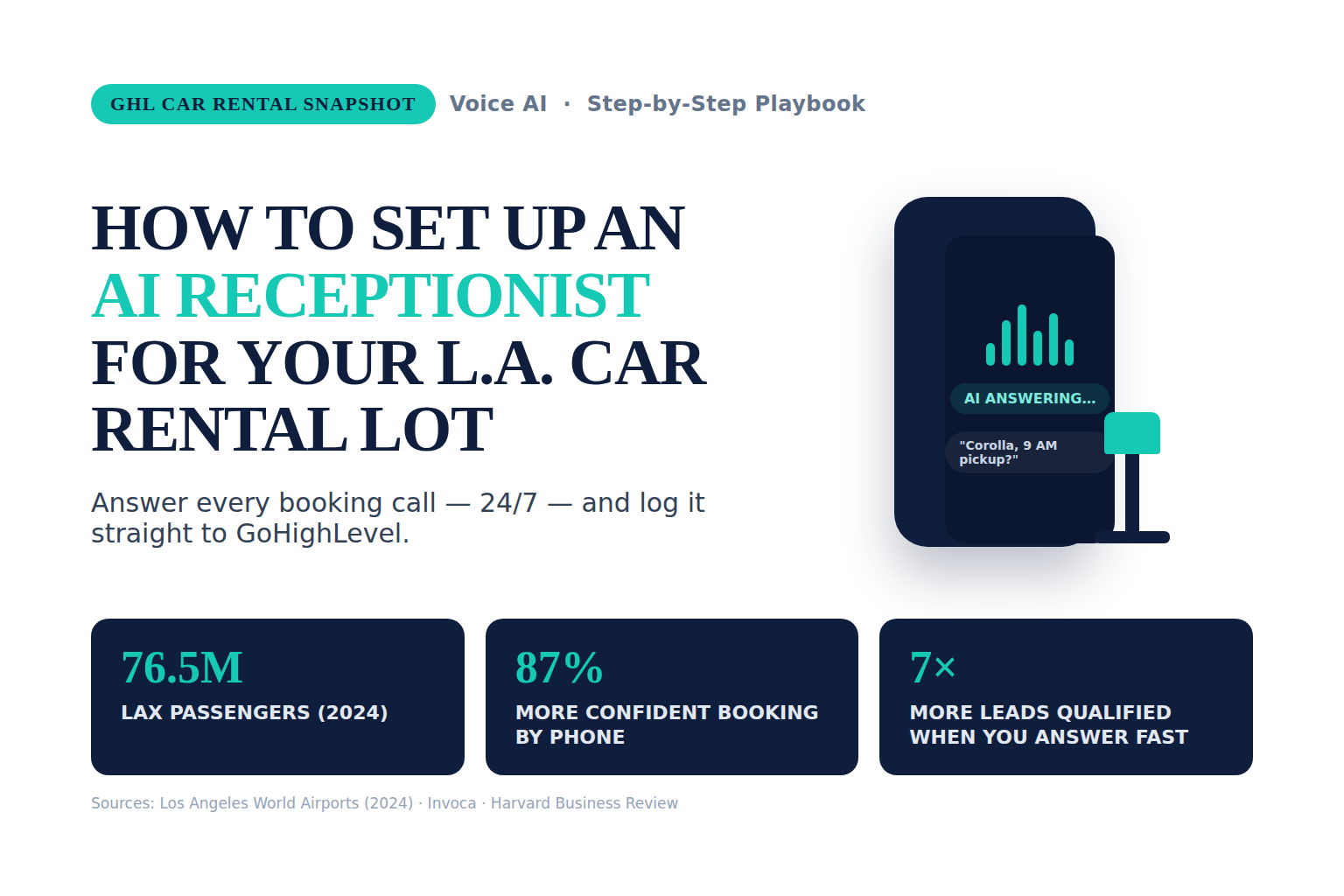
- LAX handled roughly 76.5 million passengers in 2024 (Los Angeles World Airports) and the new $1 billion Consolidated Rent-A-Car facility holds up to 21,000 vehicles (LAWA) — an around-the-clock, high-intent rental market your phone has to catch.
- 87% of consumers say talking to a person on the phone makes them more confident in a high-consideration purchase, and travel is one of the top categories people call to buy (53%), just behind automotive (61%) (Invoca). Renting a car is a phone-first decision.
- Firms that contact a web lead within an hour are ~7× more likely to qualify it — and ~60× more likely than those who wait 24+ hours — yet the average company takes 42 hours to respond and 23% never respond at all (Harvard Business Review). An AI receptionist answers in one ring.
- Contacting a lead within 5 minutes instead of 30 makes you ~21× more likely to qualify it (MIT / InsideSales Lead Response study). At night, “5 minutes” means an AI, not you.
- Small-business AI adoption jumped from 39% to 55% in a single year (Thryv, 2025). The lots competing with you on La Cienega are already testing this.
Table of contents
- What an AI receptionist actually is for a rental lot
- Why Los Angeles rental lots need one now
- Before you start: your setup checklist
- The 9-step AI receptionist build
- What it actually costs per month
- DIY vs. done-for-you
- Common mistakes that make callers hang up
- Frequently asked questions
What an AI receptionist actually is for a rental lot
An AI receptionist is a voice agent — powered by speech-to-text, a language model, and text-to-speech — that answers your phone, holds a natural back-and-forth conversation, and completes a task. For a car rental business, that task is booking-shaped: figure out what the caller wants, check whether you have it, and either take the reservation or route the call.
It is not a phone tree (“press 1 for reservations”). A modern AI receptionist listens to “do you have anything cheap for the weekend, I land tomorrow morning,” understands it, and responds like a trained front-desk agent. On a rental lot it typically handles five call types:
- Availability and quotes — “Do you have an SUV free Friday to Sunday, and what’s the rate?”
- New reservations — collecting pickup date, return date, vehicle class, and contact details, then writing them to your calendar.
- Existing-booking changes — extend a rental, change a pickup time, ask about the deposit hold.
- After-hours capture — the 11 p.m. LAX arrival that would otherwise hit voicemail.
- Overflow — the second and third calls that ring while you’re at the counter with a renter in front of you.
The point isn’t to replace the human at the counter. It’s to make sure the phone is never the reason a booking leaks away. Everything the AI does gets logged to your CRM as a real contact and a real pipeline stage — which, on this site, means GoHighLevel.
Why Los Angeles rental lots need one now
Los Angeles is one of the deepest rental markets in the country, and the demand runs 24 hours. LAX moved roughly 76.5 million passengers in 2024, with international traffic up about 7.9% to nearly 24 million (Los Angeles World Airports CY2024 report). To handle the ground-transportation demand, LAX opened a $1 billion Consolidated Rent-A-Car facility that can hold up to 21,000 vehicles (LAWA) — and every car in it competes with the independent lots in Inglewood, Culver City, and the Valley for the same travelers. Zoom out and California tourism spending hit a record $157.3 billion in 2024, supporting 1.2 million jobs (Office of the Governor of California), inside a U.S. car rental market worth roughly $35–44 billion (GM Insights; Grand View Research).
Here’s what matters for the phone: renting a car is still a call-to-buy decision. 87% of consumers say talking to a person on the phone makes them more confident in a high-consideration purchase, and 81% say simply seeing a phone number displayed makes them more confident (Invoca). Travel is one of the top categories people pick up the phone to buy — 53%, right behind automotive at 61% — and phone leads convert at about 37% on the call (Invoca). A renter with a flight booked and a deadline is exactly the caller you cannot afford to send to voicemail.
Now pair that with speed. Harvard Business Review’s audit of thousands of U.S. companies found firms replying within an hour were ~7× more likely to qualify a lead than those who waited an hour longer, and ~60× more likely than those who waited 24+ hours — yet the average company took 42 hours to respond and 23% never responded at all (HBR). The companion MIT / InsideSales study found that answering within 5 minutes instead of 30 made you ~21× more likely to qualify the lead (MIT Lead Response study). At 9 a.m. you might hit that window. At 11 p.m., only an AI does.
Before you start: your setup checklist
You can stand up a working AI receptionist in an afternoon if you have these five things ready first. Gather them before you touch any settings:
- A GoHighLevel account (or the Car Rental Snapshot installed on one) — this is where calls, contacts, and bookings will live.
- A phone number you control — either a new number the AI owns, or your existing line with conditional forwarding so unanswered calls roll to the AI.
- Your fleet and availability logic — the vehicle classes you rent, rough rate ranges, and how you’ll tell the AI what’s free (a live calendar, a simple availability sheet, or a booking system it can check).
- Your booking rules — minimum rental age, deposit/hold policy, pickup hours, and what requires a human (exotics, one-way rentals, corporate accounts).
- A short brand script — how you greet callers, your business name, and the two or three questions a human agent always asks.
The 9-step AI receptionist build
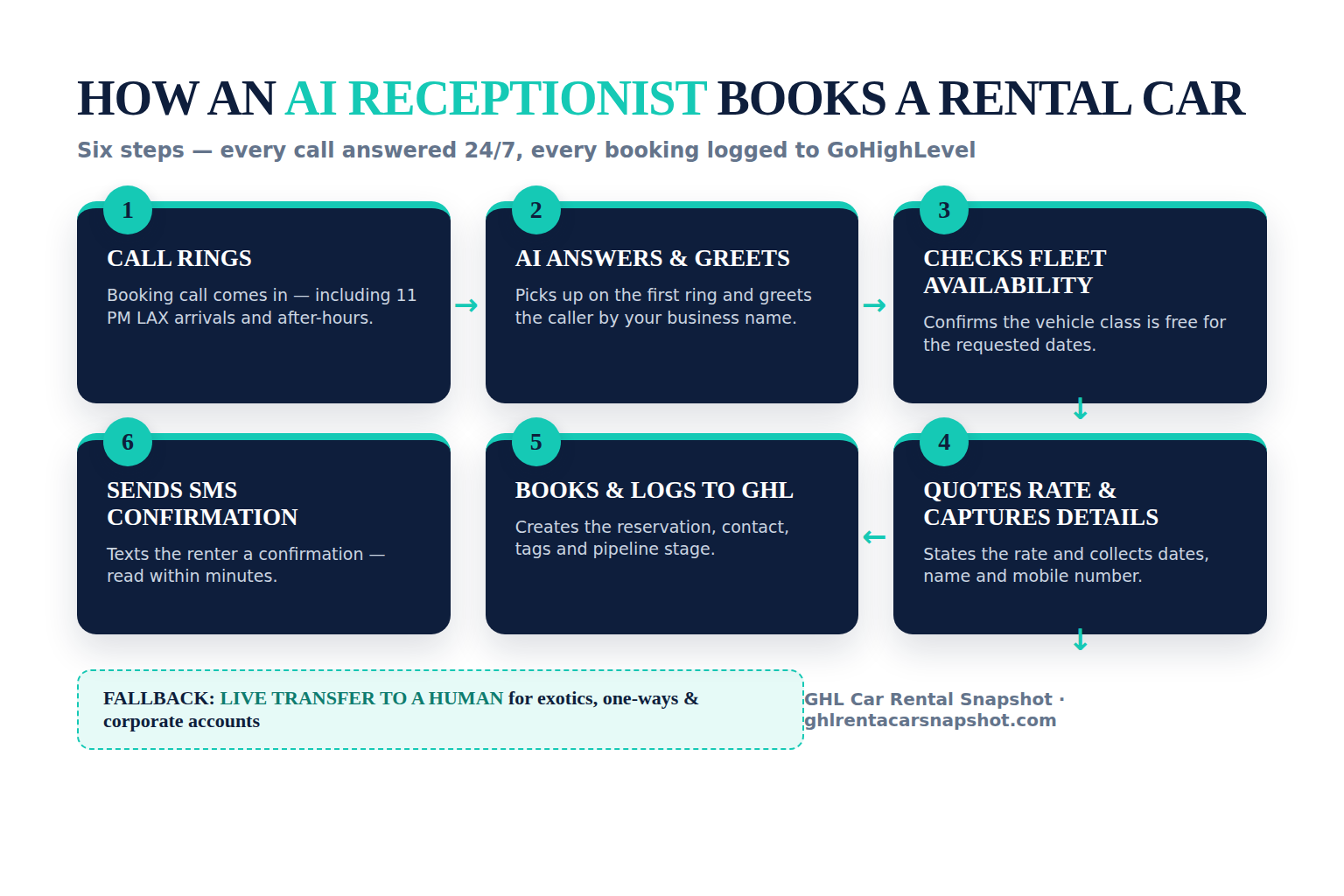
Here’s the end-to-end flow. Steps 1–3 are setup, 4–7 are the build, and 8–9 are test and tune.
Step 1 — Map the calls your lot actually gets
Take the five call types above and, for each, write the ideal outcome. “Availability” → the AI states what’s free and the rate. “New reservation” → it collects pickup date, return date, vehicle class, name, and mobile, then books. “Change” → it looks up the contact and updates the booking or flags it for a human. This map is your specification; everything after builds toward it.
Step 2 — Choose your voice stack
You have two realistic paths in 2026:
- GoHighLevel’s native Voice AI — the fastest route if you’re already in GHL. It answers inbound calls, follows your prompt, and writes back to the contact record with no extra middleware. Third-party GHL agency breakdowns put usage at roughly $0.16 per minute all-in (voice engine + speech + LLM tokens) — confirm against GoHighLevel’s own current pricing before you commit (third-party estimate, NetPartners). See our breakdown of GHL’s 2026 AI features for how this fits the wider AI Employee suite.
- A dedicated voice platform (VAPI / Retell) bridged to GHL — more control over the voice, latency, and logic (for example, a bilingual English/Spanish agent for L.A.), connected to GHL by webhook. This is the route to take when you want the receptionist to feel truly custom.
For most single-location lots, start native. Move to a bridged VAPI/Retell agent when you outgrow it.
Step 3 — Route the phone number
Decide how calls reach the AI. The cleanest setup for an existing lot is conditional call forwarding: your published number rings your counter for a few seconds, and anything unanswered — or every call after hours — forwards to the AI receptionist’s number. That way a human still catches the calls they can, and nothing rolls to voicemail. New lots can simply publish the AI’s number as the main line.
Step 4 — Write the receptionist’s brain (the prompt)
This is where most of the quality lives. Your prompt should define, in plain language:
- Identity & greeting: “You are the reservations assistant for [Lot Name], an independent car rental company near LAX. Greet callers warmly, by business name.”
- The job: qualify the caller, check availability, quote a rate, and book — or transfer.
- The questions to ask, in order: pickup date/time, return date/time, vehicle class, then name and mobile number.
- Guardrails: never quote a rate you’re unsure of; never promise a vehicle you can’t confirm; escalate exotics, one-ways, and corporate accounts to a human; confirm the caller is 25+ (or your policy age).
- Deposit language: state your card-on-file/hold policy in one clear sentence so there’s no surprise at pickup.
Keep it specific and short. A tight prompt with real rules beats a long one full of hedging.
Step 5 — Connect availability and the calendar
The receptionist is only as good as what it knows about your fleet. Give it a source of truth for availability — a GHL calendar per vehicle class, an availability sheet it can read, or an API check against your booking system — and a rule for what to do when it’s unsure (“I want to confirm that’s on the lot — can I text you a confirmation in the next few minutes?”). When it books, it should create the calendar event and the contact in one motion.
Step 6 — Wire the fallbacks
No AI books 100% of calls, and it shouldn’t try. Build three exits:
- Live transfer — for anything outside its rules, it warm-transfers to your mobile (or takes a message if you’re closed).
- Missed-call text-back — if a call drops or the caller hangs up, fire an automatic SMS: “Sorry we missed you — reply here and we’ll get your rental booked.” SMS is opened at an estimated ~98% rate and usually read within minutes (industry estimate), which is why this recovery step works. Here’s our full missed-call text-back playbook.
- Human summary — every AI call drops a transcript and a summary into the contact record so a human can pick up the thread.
Step 7 — Log everything to GoHighLevel
Every call should create or update a contact, apply tags (source: AI receptionist, vehicle class requested, after-hours), and move the person into a pipeline stage (New Inquiry → Quoted → Booked). This is what turns a phone call into a trackable, followable booking — and what lets you run reminders, deposit holds, and review requests off the back of it. Without this step you have a talking robot; with it you have a booking system.
Step 8 — Test against real L.A. scenarios
Before you point real calls at it, call it yourself and run the scenarios that actually happen:
- An 11 p.m. LAX arrival wanting a 9 a.m. pickup.
- A caller asking for a vehicle class you don’t have free (does it offer an alternative?).
- A Spanish-first caller (does your prompt or agent handle it?).
- A booking change on an existing reservation.
- An exotic or one-way request (does it escalate cleanly?).
Listen for latency, awkward hand-offs, and any rate it shouldn’t have quoted. Fix the prompt, repeat.
Step 9 — Measure and tune
Once it’s live, watch four numbers weekly: answer rate (calls picked up vs. missed), booked-call rate (calls that ended in a reservation), transfer rate (how often it needed a human), and speed-to-lead on the follow-ups. The whole reason to do this is the speed curve below — the faster the first meaningful response, the more bookings survive.
The lots that win the LAX overflow aren’t the ones with the biggest fleet — they’re the ones whose phone always gets answered. An AI receptionist is the cheapest way I know to make sure the 11 p.m. call becomes a 9 a.m. pickup instead of a voicemail nobody returns.
What it actually costs per month
The honest math depends on call volume and your stack, but the shape is predictable and small. Native GHL Voice AI at a rough ~$0.16/minute (third-party estimate) means a lot handling, say, 300 booking calls a month at an average 3 minutes is roughly $144/month in usage — plus your GoHighLevel subscription. Against a single missed weekend booking, that pays for itself fast; against the cost of a human answering the phone overnight, it isn’t close.
DIY vs. done-for-you
You can absolutely build this yourself with the nine steps above — the platforms are more accessible every quarter, and small-business AI adoption climbed from 39% to 55% in a year (Thryv, 2025), so plenty of operators are. The DIY tax is time: writing and testing the prompt, wiring availability, tuning the transfers, and keeping it from quoting a rate it shouldn’t. If you’d rather have it built right the first time — including a bilingual voice agent bridged to GoHighLevel, availability checks, and live-transfer rules made for after-hours and airport pickups — that’s exactly what our team ships.
Common mistakes that make callers hang up
An AI receptionist isn’t magic and it isn’t a gimmick. It’s the piece of infrastructure that makes sure the most valuable contact you get — a person on the phone, ready to rent — never hits a dead line. In a market like Los Angeles, where the planes land all night and the caller is comparing three lots at once, the one that answers wins. Set it up carefully, connect it to GoHighLevel so every call becomes a trackable booking, and the phone stops being the place your revenue leaks.
Frequently asked questions
What is an AI receptionist for a car rental business?
It's a voice agent — built from speech recognition, a language model, and text-to-speech — that answers your booking line 24/7, understands what the caller wants, checks fleet availability, quotes a rate, and either books the reservation or transfers to a human. Unlike a phone tree, it holds a natural conversation, and unlike voicemail, it captures the booking. Every call is logged to your CRM (GoHighLevel) as a contact and a pipeline stage so nothing falls through the cracks.
How do I set up an AI receptionist in GoHighLevel?
Nine steps: (1) map your five most common call types, (2) choose a voice stack — native GHL Voice AI or a VAPI/Retell agent bridged to GHL, (3) route your number so unanswered and after-hours calls reach the AI, (4) write a tight prompt with your greeting, questions, and guardrails, (5) connect fleet availability and your calendar, (6) wire live-transfer, missed-call text-back, and human-summary fallbacks, (7) log every call to GHL as a contact, tag, and pipeline stage, (8) test against real L.A. scenarios, and (9) measure answer rate, booked-call rate, and transfer rate weekly and tune.
How much does an AI receptionist cost for a Los Angeles rental lot?
Native GoHighLevel Voice AI runs roughly $0.16 per minute in third-party agency estimates (confirm against GoHighLevel's current pricing), plus your GHL subscription. A lot handling ~300 three-minute calls a month spends about $144 in usage — typically recovered by a single after-hours booking. A custom-built VAPI/Retell agent costs more up front but gives you full control of the voice, logic, and bilingual handling.
Will an AI receptionist replace my front-desk staff?
No — it's a safety net, not a replacement. It catches the calls a human can't: after-hours LAX arrivals, overflow while you're helping a renter at the counter, and weekend inquiries. It escalates anything outside its rules — exotics, one-ways, corporate accounts — to a person via live transfer, and it hands your team a transcript and summary of every call. You still need staff on the lot for cleaning, counter service, and damage documentation.
Does an AI receptionist work for after-hours and LAX airport calls?
That's its strongest use case. LAX handled about 76.5 million passengers in 2024 and flights arrive around the clock, so a large share of high-intent booking calls come outside business hours. An AI receptionist answers every one instantly — hitting the speed-to-lead window that research shows makes you many times more likely to win the booking — and books the 9 a.m. pickup while your competitors' phones ring out to voicemail.
About the author: Julian Cardoza is an independent fleet operations advisor in Phoenix, Arizona who spent eleven years running the counter and the back lot at rental locations across the Southwest. He learned the hard way that a full lot on paper still loses money when the phone goes to voicemail on a Friday turnaround, and now helps small and mid-size rental companies wire up GoHighLevel so no booking inquiry, deposit hold, or return reminder falls through the cracks.
Related reading:
- Missed-Call Text-Back for Car Rentals: Stop Losing Weekend Bookings
- AI Chatbots for Car Rental Businesses: Turn 24/7 Chat Into Booked Rentals
- GoHighLevel’s Newest Features for Car Rental Operators (2026): The AI Employee Playbook
- Why Houston Car Rental Businesses Are Hiring a GoHighLevel VA in 2026
- AI for Car Rental Businesses: The 2026 Automation Playbook
Editorial note: figures cited are drawn from the third-party research linked inline and reflect the sources as of publication. Speed-to-lead multipliers are from Harvard Business Review’s study of online sales leads and the companion MIT / InsideSales Lead Response Management research; phone-preference figures are from Invoca’s consumer survey and call analysis; LAX and California tourism figures are from Los Angeles World Airports and the Office of the Governor of California. The GoHighLevel Voice AI per-minute figure is a third-party agency estimate — confirm current pricing with GoHighLevel before budgeting. GHL Car Rental Snapshot builds GoHighLevel automation systems and Voice AI integrations — it is not a car rental company, insurer, or payment processor. Market data and platform pricing change; verify current sources before making decisions.